


Anyone who has ordered custom packaging more than once has encountered a spec sheet full of numbers and abbreviations that nobody explains. 32 ECT. 200# Mullen. 18pt caliper. SBS. The supplier knows what these mean. The buyer often doesn’t, and asking feels like admitting something that should already be known. This guide exists for exactly that situation. No industry jargon assumed, no engineering background required.
What Is the Difference Between ECT and Mullen Ratings?
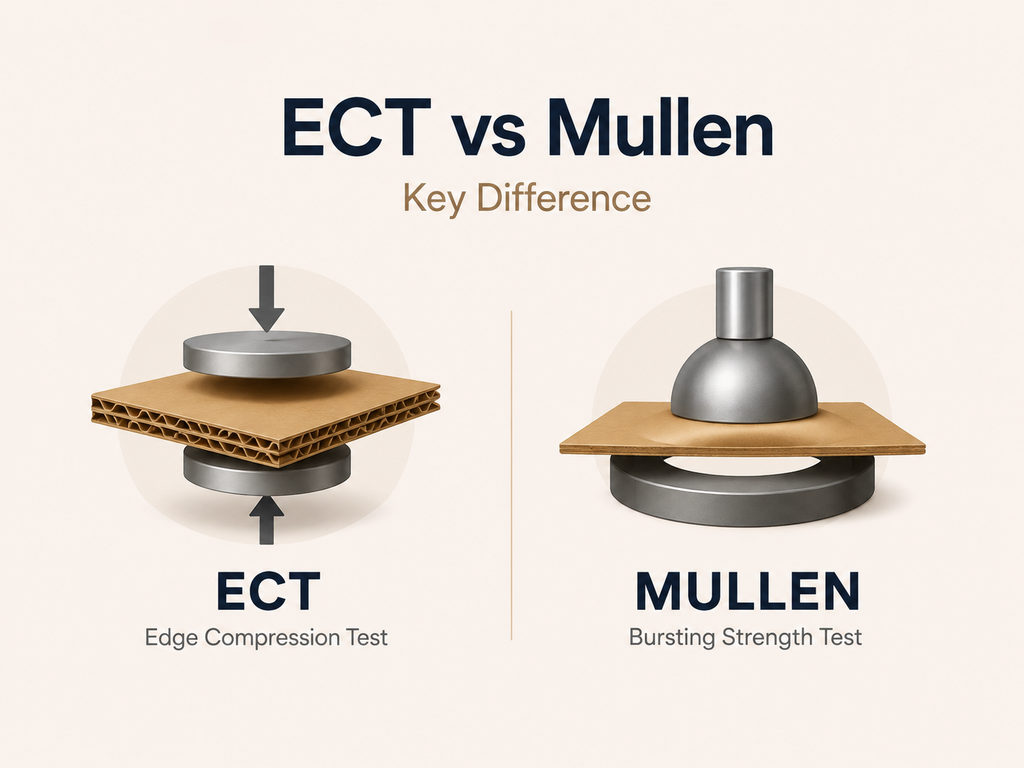
ECT and Mullen are both ways of measuring corrugated box strength, but they measure completely different things. ECT measures how much vertical pressure a box can handle before its edges collapse, which matters when boxes are stacked on pallets in warehouses. Mullen measures how much force it takes to burst a hole through the side of the box, which matters when boxes are thrown around, dropped, or squeezed during individual handling. One measures crushing from above. The other measures puncture from the side. A box can have a high ECT rating and still be vulnerable to rough individual handling, and vice versa.
What Does ECT Stand For?
ECT stands for Edge Crush Test. The test works by taking a small strip of corrugated board and crushing it vertically from the top down until the edges give way. The result, measured in pounds per inch of width, tells you how much vertical load the board can handle before it buckles. This number then feeds into calculations that estimate how much total weight a fully assembled box can support when stacked.
What Does 32 ECT Mean?
32 ECT means the corrugated board can withstand 32 pounds of force per inch of edge before the edge starts to crush. It is the most common ECT rating used in standard commercial shipping boxes and suits most products moving through palletized distribution. If your boxes will be stacked several layers high in a warehouse or on a truck, 32 ECT is the baseline to start from, not the ceiling.
Is 32 ECT the Same as 200 Mullen?
They are often listed as rough equivalents on conversion charts, and both are used for standard single-wall corrugated boxes. But they don’t measure the same property, so calling them equivalent is misleading. A 32 ECT box and a 200# Mullen box are built differently, from different fiber types, and perform differently under different stress conditions. 32 ECT will typically perform better under stack compression. 200# Mullen will typically perform better when individual packages are handled roughly or exposed to impact. They are alternatives suited to different applications rather than true equivalents.
Which Is Better, ECT or Mullen?
Neither is universally better. ECT is better for palletized shipments where vertical stack pressure is the primary risk. Mullen is better for individual parcel shipping where boxes encounter impact, drops, and rough handling without the consistent vertical loading of a pallet environment. Most commercial shipping today uses ECT because automated warehouses and palletized distribution made stacking strength the more relevant measurement. Mullen remains the right choice when boxes travel individually through less controlled handling environments.
When Should I Use ECT vs Mullen?
Use ECT when your boxes will be palletized, stacked in warehouses, and moved through automated distribution systems. Use Mullen when your products are heavy, fragile, or shipped individually through parcel carriers where boxes are sorted, thrown, and conveyed through systems that apply unpredictable impact forces rather than steady vertical load. If you’re unsure, describe your distribution path to your supplier rather than choosing a rating based on the number alone.
What Does Mullen Burst Strength Mean?
Mullen burst strength measures the force required to push through the wall of a corrugated box. A hydraulic device presses a rubber diaphragm against a flat sample of board until the board ruptures, and the pressure at that point of failure is the burst strength. It tells you how well the box resists being punctured or burst from an external force, which becomes important when individual handling creates concentrated pressure on specific points of the box rather than the distributed load of stacking.
What Does 200# Mullen Mean?
The 200# means the board can withstand 200 pounds per square inch of pressure before bursting. The pound symbol here refers to pounds per square inch of burst pressure, not the weight of the box or its contents. A higher number means more resistance to bursting. Common Mullen ratings for single-wall corrugated are 150#, 200#, and 275#, with 200# being the most widely used standard.
Is ECT or Mullen Better for Parcel Shipping?
Mullen is generally the more appropriate rating for parcel shipping environments where boxes travel individually through carrier networks. Individual parcels encounter conveyor belts, sorting machines, drops during loading and unloading, and contact with other packages that create impact and puncture risk rather than consistent vertical compression. That said, many products ship successfully in ECT-rated boxes with adequate interior cushioning, and most major carriers accept both ratings. The right answer depends on product weight, fragility, and how much handling your parcels realistically experience.
Is ECT or Mullen Better for Pallet Stacking?
ECT is the better rating for pallet stacking. It was specifically developed to measure the compression strength that matters in palletized distribution, where the boxes at the bottom of a stack carry the weight of everything above them. Mullen was developed when boxes were shipped individually by rail and individual handling was the primary risk. As palletization became standard in modern distribution, ECT became the more relevant measurement for most commercial packaging applications.
What Is Caliper in Paperboard?
Caliper is simply the physical thickness of a sheet of paperboard, measured from one surface to the other. In the United States it is expressed in points, where one point equals one thousandth of an inch. An 18pt board is 0.018 inches thick. Caliper tells you about physical thickness, which affects how rigid a box feels, how well it holds its shape on a shelf, and how it performs through scoring and folding during production. It is one of the most important specifications on a paperboard sheet and one of the most frequently overlooked in favour of GSM.
What Is the Difference Between Caliper and GSM?
GSM measures how much a square metre of the board weighs. Caliper measures how thick it is. These are related but not the same thing. A heavily coated board can have a high GSM but a relatively low caliper because the coating adds mass without adding much thickness. An uncoated board with a more porous structure might have a lower GSM but a higher caliper because its fibres create more physical bulk per gram of material. When comparing boards from different suppliers, asking for both GSM and caliper gives a more complete picture than either measurement alone.
What Does PT Mean on a Packaging Spec Sheet?
PT stands for point, the unit used to express caliper in the United States. One point equals one thousandth of an inch, so a 16pt board is 0.016 inches thick and a 24pt board is 0.024 inches thick. When a spec sheet lists a board as 18pt, it is telling you the physical thickness of the sheet. Higher point values mean thicker board, which generally means more rigidity, though the relationship between thickness and stiffness also depends on the board’s composition and fiber structure.
What Is SBS Board?
SBS stands for Solid Bleached Sulfate. It is a premium paperboard made from virgin wood pulp that has been bleached to produce a bright white surface on both sides. SBS is the most widely used board for retail folding cartons in the United States because it provides a clean, consistent surface for high-quality printing and accepts finishes including lamination, foil stamping, embossing, and spot UV reliably. Most cosmetic boxes, food cartons, and premium packaging is made from SBS.
What Is the Difference Between SBS and CRB Board?
SBS is made from virgin wood pulp and has a white surface throughout. CRB, which stands for Coated Recycled Board, is made from recycled fibres with a white clay coating applied to the top surface. CRB costs less and carries better sustainability credentials because of its recycled content. SBS provides brighter whites, more consistent printing performance, and more reliable results from specialty finishes. For most premium retail packaging where print quality and finish performance matter, SBS is the standard choice. For packaging where recycled content is a priority and print requirements are moderate, CRB is a practical and cost-effective alternative.
Why Does My Box Crush in the Warehouse Even Though the Spec Looked Right?
This is one of the most common problems in corrugated packaging, and the answer is almost always humidity. Corrugated board loses a significant portion of its stacking strength when it absorbs moisture from the surrounding environment. ECT-rated board, which tends to use more recycled fibre with shorter fibres that absorb moisture readily, can lose 40 to 50 percent of its compression strength in high-humidity warehouse conditions. A box that passed specification testing under controlled lab conditions may genuinely underperform in a warehouse that isn’t climate-controlled, particularly during humid summer months. If this is happening, the solution is usually specifying a higher ECT rating than the theoretical minimum, adding moisture-resistant coatings, or switching to Mullen-rated board whose virgin fibre content handles humidity better.
No. Higher GSM means heavier board, and heavier board is often stronger, but the relationship is not direct enough to rely on GSM as a proxy for strength. Two boards at the same GSM can have very different stiffness, caliper, and compression strength depending on their fibre composition, coating, and manufacturing process. A recycled fibre board at 400 GSM may perform less well than a virgin fibre board at 350 GSM under the same stacking load. GSM is a useful starting point for comparing materials within the same board type, but it should not be used as the sole indicator of whether a board is strong enough for a specific packaging application.
Does Higher GSM Always Mean Stronger Packaging?
No. Higher GSM means heavier board, and heavier board is often stronger, but the relationship is not direct enough to rely on GSM as a proxy for strength. Two boards at the same GSM can have very different stiffness, caliper, and compression strength depending on their fibre composition, coating, and manufacturing process. A recycled fibre board at 400 GSM may perform less well than a virgin fibre board at 350 GSM under the same stacking load. GSM is a useful starting point for comparing materials within the same board type, but it should not be used as the sole indicator of whether a board is strong enough for a specific packaging application.
Does Recycled Content Affect Board Strength?
Yes, meaningfully. Recycled fibres are shorter than virgin fibres because they have been processed at least once before. Shorter fibres create less interwoven structure within the board, which reduces burst strength and moisture resistance compared to virgin fibre boards of equivalent weight. This is why ECT-rated board, which typically uses higher recycled content, is more vulnerable to humidity-related strength loss than Mullen-rated board. It is also why recycled content boards generally perform well enough for most standard applications but are not always the right choice for products that are heavy, fragile, or moving through rough distribution environments.