

The packaging decision that looks like a cost reduction on a spreadsheet and a cost problem in practice follows a consistent pattern. A brand running procurement optimization identifies packaging as a category where per-unit savings are achievable. A cheaper supplier is found. The savings appear immediately on the COGS line. Three months later, damage complaints are up. Returns are running higher. The fulfillment team is slower because the cheaper boxes are harder to assemble. A retail buyer has flagged a print quality concern. None of these downstream costs appear on the packaging budget line where the saving was recorded, which is precisely why cheap packaging decisions persist across organizations that would immediately reverse them if the costs were visible in the same ledger as the savings.
Unit cost answers one question: what does it cost to purchase this packaging? Total cost of ownership answers a different one: what does it cost to use it? These numbers diverge the moment packaging quality affects anything downstream, including packing speed, damage rates, return volume, and storage efficiency.
Packaging accounts for 10 to 15 percent of total fulfillment costs, the second-largest expense after labour. But that number only captures material cost. It doesn’t touch what happens after the box leaves your dock.
What Is the Difference Between Unit Cost and Total Cost of Ownership for Packaging?

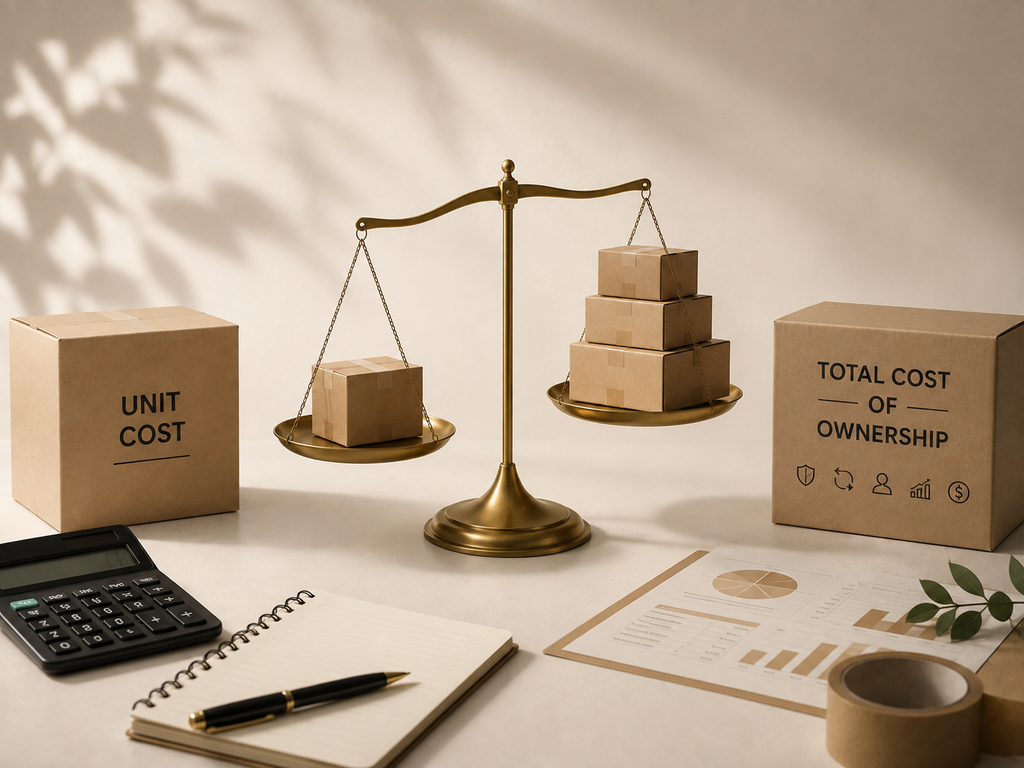
The unit cost of packaging is the price paid per box, pouch, or unit to the packaging supplier. It is the figure that appears on the purchase order and that procurement teams track as the primary measure of packaging cost performance. It is also the figure that conceals the largest proportion of packaging’s true financial impact on the business.
The box was 3 cents cheaper. The returns were 11 cents higher. That was a very expensive conversation.
Total cost of ownership for packaging measures what it actually costs to use a packaging specification across the full operational cycle rather than what it costs to purchase. The components of total cost that unit cost excludes include the labour cost of assembling and packing with packaging that is slower or harder to work with than alternatives, the damage cost from packaging that fails to protect products through distribution, the return cost from products returned because of packaging-related damage or presentation failure, the customer service cost of handling complaints from packaging failures, the brand cost from customers who don’t return after a poor packaging experience, and the regulatory cost from packaging that doesn’t meet compliance requirements.
Cheap packaging is a margin decision dressed up as a cost decision. It shows up as a win on your COGS line, then quietly takes that win back across return rates, repeat purchase, brand perception, and customer acquisition cost. Most brands never connect the dots because the costs land in different ledgers, but the math is real.
What Are the Actual Hidden Costs of Cheap Packaging?
The hidden costs of cheap packaging distribute across operational categories in ways that make each individual cost appear manageable while the combined impact significantly exceeds the savings that motivated the cheap packaging decision.
Damage rates are the most directly traceable hidden cost. A 1 to 2 percent increase in damage rates can wipe out perceived material savings instantly. Protective performance must be engineered, not assumed.
Damage replacement cost equals your defect rate times the cost of a full replacement order, including shipping both ways. Every damaged unit is a refund, a replacement, two rounds of shipping, and a customer who tells five friends.
The per-incident cost of a damaged shipment includes the replacement product cost, outbound replacement shipping, and in many cases inbound return shipping for the damaged product. For a product with a landed cost of $15 and a replacement shipping cost of $8, a single damage incident costs $23 in direct replacement expense before any customer service time or brand impact is accounted for. A packaging specification that saves $0.15 per unit but increases damage rate by 1 percent generates $0.23 in replacement cost per unit shipped, a net cost increase of $0.08 per unit that the unit cost comparison never revealed.
Return rates from packaging failures add a second cost layer that amplifies the damage cost. Return rate driven by arrival condition represents customers who receive a beat-up package and return at materially higher rates, even if the product is fine. Returns from packaging condition generate the full replacement cost plus return processing cost, and the customer who returns a product because of packaging failure has a measurably lower probability of repurchasing than a customer whose product arrived in acceptable condition.
Cheap packaging leads to damaged goods, returns, and customer dissatisfaction. When customers consistently receive products in well-designed, protective packaging, they’re more likely to repurchase and recommend.
Labour efficiency losses from packaging that is slower or harder to assemble create a cost category that operations teams experience but rarely connect back to packaging specification decisions. If packaging adds 3 to 5 seconds per unit on a high-volume line, the labour cost can exceed material savings quickly. And in today’s labour market, efficiency equals resilience.
For a fulfillment operation packing 1,000 units per shift at $18 per hour including overhead, a 5-second increase in pack time per unit adds 83 minutes of labour per shift, or approximately $25 in additional daily labour cost. Over 250 working days this accumulates to $6,250 in annual additional labour from a packaging decision that may have saved $0.05 per unit in material cost, which at 1,000 units per day saves $12,500 annually. The packaging looked like it saved money. It saved half as much as it appeared to while creating operational friction that the saving calculation never modelled.
Does Cheap Packaging Really Affect Brand Perception and Repeat Purchase?
The brands with the most premium unboxing experiences in our client base have 15 to 30 percent higher repeat purchase rates than their direct competitors with stock packaging.
The repeat purchase rate differential from packaging quality represents one of the largest and least tracked financial impacts of cheap packaging decisions because it accumulates slowly across customer cohorts rather than appearing as a discrete event in financial reporting. A customer whose first purchase arrived in damaged or visually inferior packaging makes a repeat purchase decision against a baseline expectation of poor packaging, and a meaningful proportion of those customers don’t make that repeat purchase at all.
Low-cost vendors often lack quality control. Variations in size or print cause line stoppages, rework, and even brand inconsistencies.
Organic content and user-generated content represent free acquisition. Every social post a customer makes of your unboxing is free acquisition. Boring packaging gets zero posts.
The social sharing cost that cheap packaging creates through its absence is the most difficult hidden cost to quantify but among the most commercially significant for direct-to-consumer brands whose customer acquisition costs are high. A packaging experience worth photographing and sharing generates content that reaches the sharer’s network at zero acquisition cost. A packaging experience that doesn’t warrant documentation generates no content regardless of how good the product inside is.
Cheap packaging may lower upfront costs, but often leads to hidden expenses in rework, product returns, and lost brand trust. Once your brand loses trust, it’s hard to rebuild. I’ve seen clients lose their shelf space over minor packaging issues.
How Do You Calculate the True Total Cost of Cheap Packaging?
A five-point framework for running total cost analysis: Material cost per order, not per unit of packaging purchased, but per order shipped, factoring in the full assembly including box, mailer, void fill, tape, labels, and inserts. What is the actual materials cost of one complete packed shipment? Damage and returns rate times cost per incident.
The calculation framework that produces an accurate total cost comparison between cheap and premium packaging requires populating five cost categories with actual operational data rather than theoretical estimates.
The first category is material cost per shipment, the total cost of all packaging components used per order rather than per packaging unit purchased. A brand buying boxes at $0.45 each but using $0.12 of void fill, $0.05 of tape, and $0.08 of labels per shipment is spending $0.70 per shipment in packaging materials rather than $0.45. Comparing this $0.70 against a premium box at $0.65 that requires less void fill shows a smaller cost differential than the unit cost comparison suggests.
The second category is damage cost per shipment, calculated as the damage rate multiplied by the per-incident replacement cost. A brand with a 3 percent damage rate and a $22 per-incident cost is carrying $0.66 of damage cost per shipment. A premium packaging specification that reduces the damage rate to 1 percent reduces this to $0.22, recovering $0.44 per shipment in damage cost against whatever premium the better packaging carries.
The third category is labour cost per shipment from packaging assembly and packing. Operations data on pack time per unit, multiplied by the fully loaded hourly labour cost, produces the labour cost per shipment that packaging specification directly affects.
The fourth category is return rate cost, calculated as the percentage of returns attributable to packaging condition multiplied by the per-return cost including processing, inspection, restocking or disposal, and replacement shipping. Retail operations with return rate tracking by reason code can isolate the packaging-condition component. Operations without this tracking can estimate by comparing return rates before and after packaging specification changes.
The fifth category is regulatory and compliance cost from packaging that creates EPR fee liability, fails retailer compliance standards, or generates labelling violations. Brands without a documentation system are guessing at their reporting obligations and at risk of fees and penalties on supply they can’t account for. Operational fire drills, the reactive cost of a compliance problem, pulling inventory, contacting suppliers, and generating documentation retroactively, often cost far more than building compliance into procurement from the start.
Does Cheap Packaging Always Cost More in the Long Run?
Not always, and claiming it does without analysis substitutes a generalisation for the specific calculation that each packaging decision requires. Cheap packaging that performs adequately for a specific product, distribution environment, and customer expectation profile may genuinely represent better total cost than premium packaging whose additional cost exceeds the operational benefits it delivers.
It’s possible to overspend without realising it. Overspecification often happens when packaging is designed once and never re-evaluated. A structured packaging evaluation frequently uncovers material reduction opportunities without compromising performance. Smarter engineering beats heavier engineering.
The packaging decisions where cheap typically costs more are those where the protection requirement, the customer experience expectation, or the compliance requirement of the application genuinely exceeds what the cheaper specification delivers. Products that are fragile, high-value, or sold to customers whose repurchase decision is significantly influenced by unboxing experience are the clearest cases where cheap packaging’s downstream costs reliably exceed its unit cost savings.
The packaging decisions where cheap may represent genuine value are those where the product is robust, the distribution environment is controlled, and the customer experience expectation is functional rather than experiential. Commodity products shipping through controlled fulfilment environments to customers whose purchasing decisions are primarily price-driven may be genuinely served by packaging whose specification matches the application without over-engineering for a customer experience outcome the customer doesn’t value.
If you want the shortest useful definition of what is packaging lifecycle cost assessment, here it is: measure the real total cost of packaging, not just the upfront quote, so you can make a decision that protects both margin and product.
What Questions Should Brands Ask Before Choosing Cheaper Packaging?
Ask about rush fees, colour matching, insert assembly, reprint charges, sample courier costs, and storage fees. Ask whether the quote includes master cartons, pallet wrapping, and export labelling. Ask whether the supplier will bill for 3 percent overage or absorb it. If you don’t ask, you’re volunteering to pay for the surprise later.
The questions that reveal whether a cheaper packaging option genuinely costs less or simply appears to begin with distribution performance rather than with price. What is the damage rate history for this specification on comparable products? What is the pack time per unit on this specification at our throughput volume? What compliance documentation does this specification provide for our retail channels and EPR reporting requirements?
Low-cost vendors often lack quality control. Variations in size or print cause line stoppages, rework, and even brand inconsistencies.
Supplier quality management capability is a question cheap packaging evaluation consistently skips. A supplier whose quality management produces consistent specification compliance across production batches may cost more per unit than a supplier whose inconsistency requires rework, line stoppages, and reprint investments that consume the unit cost saving. Asking specifically about batch-to-batch consistency, inspection protocols, and defect rate history provides the quality performance data that unit cost comparisons omit.
Work with verified suppliers, request detailed samples, and focus on total cost, not just unit price. Sometimes, it’s better to invest in packaging that performs reliably than to cut costs and face the consequences.
The sample evaluation process that should precede any packaging specification decision includes testing under realistic distribution conditions rather than only visual and dimensional inspection. A sample that looks adequate on a desk may fail a simple drop test or exhibit print adhesion problems under humidity exposure that the distribution environment will produce. Testing samples under representative conditions before committing production investment reveals performance gaps that visual inspection consistently misses and that cheap packaging consistently contains.