


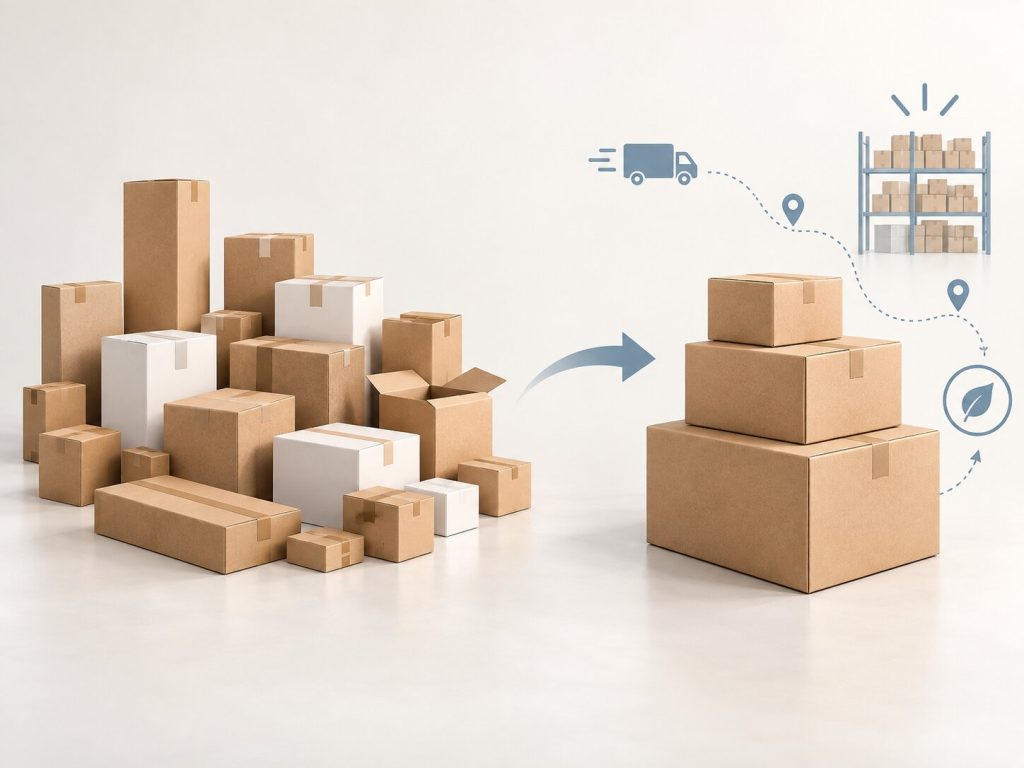
The decision to use different box sizes for different products in a range feels like the obviously correct one when it’s made. Product A is longer, so it gets a longer box. Product B is wider, so it gets a wider box. Product C has an unusual shape, so it gets a box dimensioned specifically for it. Each individual decision is defensible. The collective consequence of all those individual decisions is an inventory complexity problem whose cost appears across shipping, warehousing, procurement, production, and operations in ways that are difficult to track back to the packaging brief that created them.
The research is specific about the scale of this problem. A company needing ten different box sizes versus just three standardized ones can negotiate much better prices for the materials of those three sizes. A warehouse managing 23 box sizes for shipping costs itself thousands in wasted shipping fees, extra labor hours spent deciding which box fits which product, and irregular inventory patterns where some sizes sit collecting dust while others require emergency reorders. The financial benefit of packaging standardization is not limited to the unit price. A narrower packaging range can reduce tooling duplication, sample iterations, obsolete inventory, setup changes, emergency purchases, and small-volume orders.
Understanding where these savings actually come from, and why they consistently exceed the cost of the standardisation exercise that produces them, is the practical value this blog provides.
Why Do Brands End Up With Too Many Box Sizes in the First Place?
The box proliferation problem rarely starts with a single bad decision. It accumulates through a series of reasonable responses to individual product requirements made at different points in time, by different people, without reference to a packaging architecture that applies across the range.
A product launch team specifying a new product’s packaging brief looks at that product’s dimensions, selects a box that fits it, and moves on. Six months later, a different product launch produces a slightly different brief, which produces a slightly different box. Over two to three years of product launches, the result is a range of products each with its own box specification, each requiring its own inventory management, its own reorder cycle, and its own supplier relationship or SKU within an existing supplier relationship.
The cost of this proliferation is invisible in any individual product’s packaging cost line because each box was competitively priced for its specific specification. The total cost only becomes visible when operations teams map the full complexity across all boxes simultaneously and discover that managing ten specifications costs substantially more in labour, storage, procurement complexity, and shipping inefficiency than managing three would.
What Does Dimensional Weight Do to the Cost of Non-Standard Boxes?
The dimensional weight pricing that parcel carriers apply to shipments is one of the most direct and calculable costs of box size proliferation, and it provides some of the clearest data on what non-standardised box sizes cost across a shipping operation.
Dimensional weight pricing calculates shipping charges based on the volume of the package rather than its actual weight when that volume-based weight exceeds the package’s real weight. A 3-pound item in a 12 by 12 by 12 inch box might have a dimensional weight of 12.4 pounds, making you pay four times for shipping relative to the product’s actual weight. This is precisely why right-sizing is critical for profitability.
The calculation that reveals standardisation’s shipping cost benefit takes the current range of box sizes, calculates the dimensional weight charge for each, and compares it against the dimensional weight charge for a standardised range of three to four sizes that adequately serves all products. After right-sizing to an optimal box dimension, real-world examples show annual savings of $168,000 for operations shipping 10,000 monthly units. The savings come from three sources simultaneously: reduced dimensional weight charges, reduced void fill material required to fill oversized boxes, and faster packing from not having to select between many size options.
How Does Box Proliferation Affect Warehouse Operations?
The warehouse cost of managing multiple box sizes distributes across storage, picking, inventory management, and labour in ways that accumulate into significant operational cost without any single cost centre recording the full impact of the packaging decision that caused it.
Storage cost is the most straightforward element. Different box sizes can’t be stacked interchangeably, they require designated storage zones, and the zone sizes need to accommodate peak inventory levels for each size rather than average levels. A warehouse storing ten box sizes needs ten designated zones, each sized to accommodate the maximum inventory level of that specific size, whose combined footprint is substantially larger than the footprint required for three standardised sizes at equivalent total unit count.
By minimising the range of packaging materials and size, a company can order large quantities and have low costs of holding inventory, and enjoy economies of scale. The uniformity of packaging results in better palletisation, stacking, and transportation. Standardised sizes occupy maximum space in containers and in trucks, minimising the number of deliveries and their logistics costs.
Picking and packing labour is where the operational cost of box proliferation is most consistently underestimated. When your packaging follows a consistent structure, it becomes easier to manage weight thresholds, reduce wasted space, and stay within dimensional weight guidelines. Your team spends less time choosing packaging and more time shipping orders efficiently. For operations teams managing hundreds or thousands of daily shipments, standardisation introduces repeatability that reduces the decision fatigue and selection errors that box proliferation creates at the pack station.
What Procurement Savings Does Standardisation Actually Produce?
The procurement saving from box standardisation is both the most straightforwardly calculable benefit and the one that gets the most attention in the standardisation conversation, because it appears directly in the packaging budget line where management can see and measure it.
Volume concentration on fewer box specifications allows a brand to order larger quantities of each specification, accessing the price tier breaks that packaging suppliers apply to larger production runs. A brand ordering 5,000 units of each of ten different box sizes is placing ten orders of 5,000 units, each at a per-unit price reflecting that quantity. A brand ordering 15,000 units of each of three standardised sizes is placing three orders of 15,000 units, each at a per-unit price reflecting that larger quantity. The per-unit saving between 5,000 and 15,000 units varies by supplier and specification but is typically 15 to 35 percent across the quantity break, a saving that applies to every unit ordered rather than only to the marginal units above a threshold.
Tooling cost concentration produces a parallel saving when structural dies, printing plates, or moulding tooling costs are divided across fewer specifications. A brand maintaining ten box specifications maintains ten sets of tooling whose individual amortisation costs divide across smaller per-specification volume. The same tooling investment concentrated in three specifications divides across larger per-specification volume, reducing the tooling cost per unit across the standardised range.
Supplier relationship simplification from dealing with fewer specifications produces administrative savings that don’t appear on any single budget line but represent real management time. Fewer specifications mean fewer change requests, fewer proof cycles, fewer quality disputes, and fewer reorder calculations. The financial benefit of standardisation is not limited to the unit price. A narrower packaging range reduces sample iterations, obsolete inventory, setup changes, and emergency purchases.
What Does Standardisation Do to Brand Consistency?
The brand consistency benefit of box standardisation is the dimension most often underweighted in the standardisation cost-benefit analysis because it’s harder to quantify than shipping or procurement savings and easier to dismiss as a subjective aesthetic preference rather than a commercial performance factor.
Standardised packaging, when applied consistently across a product range, gives increased exposure and continuity of the brand. It has the benefits of making product displays neater and more appealing to consumers, as well as making the design and printing process simpler across SKUs. The visual coherence of a product range presented in boxes of the same structural specification, differing only in the printed surface design that distinguishes each product variant, communicates design intentionality that a range presented in varied box sizes and structures doesn’t achieve as reliably.
Retail shelf presence compounds this brand consistency benefit because a product range occupying a consistent structural footprint across all SKUs creates a more visually coherent shelf block than a range whose varied box dimensions create uneven heights, depths, and widths across adjacent facings. A uniform shelf block is easier for category managers to plan for and more visually appealing to shoppers than a range whose dimensions require individual planogram accommodation for each SKU.
Does Standardisation Work for Every Product Range?
No, and acknowledging where it doesn’t work prevents the standardisation exercise from creating new problems while solving old ones.
The one-size-fits-all approach is specifically identified as a common e-commerce packaging mistake. Using a single box size for all products results in massive dimensional-weight premiums and excess void fill. The solution is segmenting products by type and right-sizing each category. Even three to four standard sizes dramatically reduce costs.
The practical standard for most product ranges is a small number of standardised sizes, typically three to five, that cover the full dimension range of the product portfolio with adequate fit for each product rather than a precise fit for none of them. Products whose dimensions cluster naturally into size groups are candidates for standardisation within each group. Products with unusual dimensions whose standardised alternative would require significantly oversized packaging or significant product redesign are candidates for individual specification.
The standardisation exercise that produces the best outcome starts with a dimensional audit of every product in the range, maps the distribution of dimensions, identifies the three to five size clusters that cover the range with minimum average dimensional waste, and specifies standard sizes at the cluster centres. Packaging standardisation helps brands reduce complexity, control costs, improve protection, and build more efficient packaging systems. The most practical approach combines repeatable packaging platforms with enough flexibility for product protection, brand presentation, and market-specific requirements.
What Is the Right Way to Approach a Standardisation Project?
A standardisation project that produces durable results rather than a new set of exceptions that recreates proliferation over time requires a clear process whose output is a documented packaging architecture that new products are measured against rather than automatically accommodated with new specifications.
The dimensional audit that begins the project needs to cover every active packaging specification currently in use, the current order volume of each, the total cost of each including unit price, storage, shipping, and any premium charges for small-volume orders. This total cost mapping, rather than per-unit price comparison, reveals the true cost differential between the current state and the standardised alternative.
The standardised size set that the audit produces needs to be documented as a packaging architecture rather than as a recommendation, meaning it becomes the set of approved sizes from which all future product launches select rather than a starting point that can be overridden for individual product convenience. The exceptions process should require active approval from a defined decision-maker with access to the full cost model, rather than defaulting to accommodation of individual product team preferences.
Regular review of the standardised size set, typically annually, allows the architecture to evolve as the product range changes without requiring a full reprospect exercise every time a new product cluster emerges at the edges of the current size set.