


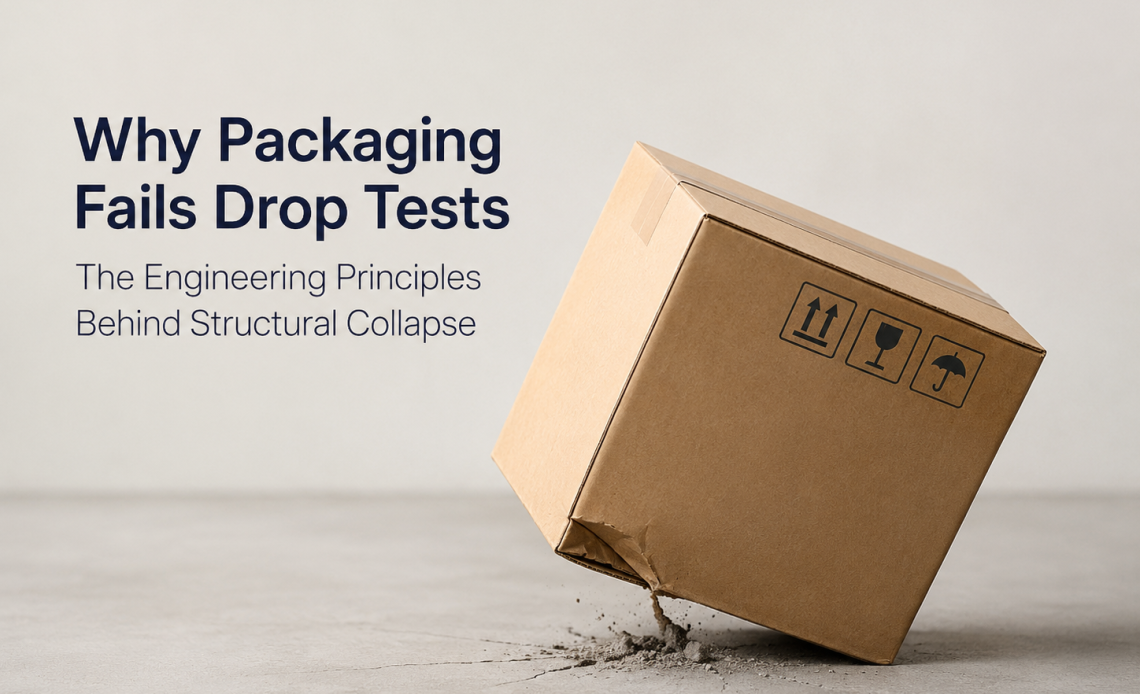
A package that looks robust sitting on a desk fails a drop test for reasons that have nothing to do with how it looks and everything to do with physics that packaging design frequently doesn’t account for. The company that built it used decent materials. The box held its shape during quality inspection. The print looked sharp and the corners were clean. Then it dropped from thirty inches onto concrete in a standard ISTA simulation and the corner separated, the product shifted against the interior wall, and the test recorded a failure that nobody in the design process anticipated because nobody in the design process had asked where the impact energy was going to go.
Drop test failure is one of the more instructive categories of packaging problem because it reveals the gap between packaging that is adequate under static conditions and packaging that performs under dynamic loading. These are genuinely different engineering problems, and a packaging specification process that only considers the first while assuming the second will be fine generates drop test failures with the consistency of a predictable outcome rather than a surprising one.
What Actually Happens When a Package Is Dropped?

When a package hits a surface, it experiences an impact force that is substantially higher than the weight of the package during static conditions. The force generated on impact is a function of the package’s mass, the drop height, and the deceleration distance over which the kinetic energy dissipates when the package contacts the surface. A package dropped from thirty inches builds kinetic energy during the fall and then attempts to dissipate that energy in milliseconds when it contacts the ground.
Drop tests reveal how impact energy travels through the package. Ideally, energy should be absorbed by sacrificial elements such as cushioning materials or structural reinforcements. When energy bypasses these elements and reaches the product, damage becomes more likely.
The deceleration problem is where most drop test failures originate. A package whose structure is rigid with no energy-absorbing elements transmits impact force directly through the structure to the product because the structure stops moving instantaneously while the product inside tries to continue moving at the velocity it had just before impact. This internal product movement creates forces on the product and on the packaging interior that are concentrated at the points of contact between product and packaging surface, which are typically corners and edges rather than flat panel areas.
Without proper void fill, custom inserts, or corrugated dividers, the products inside can shift during transit. This shifting creates uneven weight distribution, putting extreme localised pressure on a single wall and causing a blowout.
Why Do Corners Fail Before Flat Panels?
Corner failures are the most consistent pattern in drop test results and the most consistently misunderstood. When a package lands on a flat face, the impact force is distributed across the full panel area. When a package lands on a corner, which happens regularly in real distribution handling and is specifically tested in drop test protocols, the same impact force concentrates at the corner junction rather than distributing across any significant area.
Each failure mode points to a specific design weakness. Drop tests reveal how impact energy travels through the package.
The corner concentration effect amplifies local stress to levels that far exceed what the material specification at that point can absorb. Board that would handle the same force easily if it were applied as a distributed pressure across a full panel fails when the same force is concentrated at a corner measuring a few centimetres of edge length. The ratio between the force applied and the area over which it concentrates determines the local stress, and corners concentrate this ratio into territory that most standard corrugated board specifications weren’t engineered to survive.
Corner construction quality compounds this inherent geometry problem. A corner joint held together by adequate glue coverage and proper board overlap resists corner drop failure significantly better than a corner held by minimal adhesive and insufficient overlap. The adhesive joint at the corner needs to resist both the shear force of the impact and the peel force created when the two panels it joins try to separate rather than deform together. Corners constructed below minimum overlap and adhesive standards fail at the joint before the board itself reaches its stress limit.
Why Does Packaging Fail Drop Tests Even After Passing Inspection?
This is the question that generates the most genuine frustration among brands and manufacturers, and it has a specific engineering answer rather than being a random quality variability problem.
Over time, compression loads and environmental exposure can weaken packaging structures even if they initially passed testing. Packaging tests assume controlled handling procedures, but real distribution involves human operators and equipment variability. Forklift handling, pallet stacking, and loading procedures can vary between facilities.
The more common version of this problem isn’t environmental degradation but test scope. Static quality inspection checks whether the package meets its dimensional specification and whether the print and structure look correct under examination conditions. Drop testing checks whether the package maintains its protective function under dynamic loading conditions that inspection procedures don’t replicate. These are different tests of different properties, and a package can pass one while failing the other because the properties being checked don’t overlap.
Another reason packaging may fail after testing is that tests often focus on individual packaging components rather than the entire packaging system. A shipping container may pass a drop test, but the pallet configuration, internal packaging, and stacking loads may create different stresses during distribution.
Product changes that aren’t accompanied by packaging updates are a specific and frequently occurring cause of field failures that had previously passed testing. A slight increase in product weight, a new component, or a change in centre of gravity can alter how forces are distributed during transport. Reusing old packaging designs for updated products often results in unexpected damage. The packaging wasn’t suddenly inferior. The force distribution profile of the packaged assembly changed in a way that the existing packaging wasn’t engineered to handle.
What Is the Role of Cushioning and Why Does Too Much Protection Create Failure?
Cushioning is where the most counterintuitive drop test failure mechanism operates, and understanding it requires moving away from the intuition that harder and denser materials absorb more impact.
Many people assume that the hardest possible foam offers the best protection. In fact, the opposite can be true. If the material is too stiff, the impact energy is hardly absorbed and instead transferred directly to the product. The measured accelerations, G-values, increase significantly. An optimally designed foam works like a spring: it yields in a controlled manner and converts some of the impact energy into deformation.
The cushioning function requires a material that deforms progressively under impact rather than either deforming instantly at low force or not deforming at all. A material that deforms instantly under low force provides no meaningful deceleration distance because it compresses to its minimum thickness before the impact force has been meaningfully absorbed. A material that doesn’t deform under impact force transmits the full impact force to whatever it’s in contact with, which is the product.
Besides the material hardness, the available padding thickness plays a crucial role. The greater the spring travel, the longer the shock can be absorbed. This spring travel principle means that the same cushioning material performs differently at different thicknesses, with thicker cushioning providing more travel and therefore more effective deceleration than thinner cushioning of the same material.
The mismatch between cushioning specification and product fragility is the most common cushioning-related drop test failure. Products with low fragility, measured in G-values, the maximum deceleration they can withstand without damage, need cushioning designed for that specific fragility threshold. The cause usually lies in a combination of the insert’s design, material selection, and a lack of compatibility with the product, geometry, and load profile. Cushioning designed without knowing the product’s fragility level is designed without the most important input the design requires.
Why Do Some Packages Pass Face Drops but Fail Corner Drops?
Different orientations often produce different outcomes. A package may pass face drops but fail corner drops. This information helps refine handling guidelines, pallet patterns, and labeling.
The orientation-specific failure pattern reveals that the package’s structural performance isn’t uniform in all directions, which is expected for rectangular packages whose face, edge, and corner drop performance reflect different structural mechanisms. Face drops test panel stiffness and cushioning compression capacity. Edge drops test the resistance of panel-to-panel joints to peeling separation under the bending moment created when one panel continues moving and the adjacent panel is arrested by the surface contact. Corner drops test the extreme stress concentration at the structural intersection point where three panels and three joints meet simultaneously.
A package that passes face drops comfortably but fails corner drops has adequate panel stiffness and cushioning but inadequate corner construction. The fix isn’t changing the panel specification. It’s improving corner construction through better adhesive coverage, adequate board overlap at corners, and potentially reinforcement materials at corner areas that carry the highest stress concentration during the specific failure-causing orientation.
Understanding which orientation is causing failure in drop testing directs the structural improvement to the correct location rather than prompting a wholesale specification upgrade that increases cost without addressing the specific failure mechanism.
What Does Humidity Do to Drop Test Performance?
Sustainability initiatives can also introduce risk if not carefully managed. Reducing packaging material or switching to eco-friendly alternatives without understanding their mechanical limits may increase damage rates.
Humidity is one of the most reliably damaging environmental factors for corrugated and paperboard packaging structural performance, and it operates on the same material properties that drop test performance depends on. The compressive strength and stiffness that determine drop test performance in corrugated packaging are both moisture-sensitive because the paperboard fibres that provide these properties lose their structural integrity as they absorb moisture from the surrounding environment.
Packaging that looks robust on paper can fail once exposed to sustained vibration from road or rail transport. Micro-movements gradually weaken carton walls, loosen internal fixings, or cause products to rub against protective inserts. Over time, this leads to abrasion, cracking or collapse.
Packaging tested under laboratory humidity conditions may fail in the field under higher ambient humidity because the material properties measured during testing don’t represent the material properties at the time of actual drop impact. A package that passes a 30-inch drop test at 50 percent relative humidity in a controlled laboratory environment may fail the same drop test at 80 percent relative humidity because the board’s compressive strength has been reduced by moisture absorption to below the level the test requires.
This humidity sensitivity is particularly relevant for packaging that moves through multiple climate zones during distribution, or that spends time in uncontrolled storage environments where summer humidity drives moisture content above laboratory test conditions. Designing to the lowest expected structural performance rather than to median performance provides the margin that accounts for this environmental variability.
What Is the Relationship Between Box Size and Drop Test Performance?
Box size relative to product size is one of the packaging decisions with the most direct and predictable impact on drop test performance, and it’s also one of the decisions most commonly made on criteria other than structural performance.
Boxes collapse when the external pressure exceeds the structural limits of the corrugated fluting, or when there is too much empty void space inside the box, causing the walls to fold inward under stress.
Oversized packaging creates two simultaneous failure mechanisms. The first is the void space problem: product movement inside an oversized box during a drop creates the internal impact forces that a correctly sized box eliminates by restricting movement. The second is the panel unsupported span problem: larger panel areas between corner supports have longer unsupported spans that buckle under lower compressive loads than shorter unsupported spans in correctly sized boxes.
The engineering consequence of these two mechanisms is that an undersized package specification, in terms of board grade and construction, in a correctly sized box often outperforms a specification that looks adequate in an oversized box. The correctly sized box uses the product itself as an internal structural element, with the product occupying the interior volume and preventing the panel inward movement that creates both failure mechanisms simultaneously.
How Do You Identify the Root Cause of a Drop Test Failure?
Drop tests help pinpoint weak spots in packaging designs. For instance, if a specific area consistently fails during testing, engineers can reinforce that section or redesign it to distribute stress more evenly. These findings also guide material choices, whether the priority is improving structural strength or enhancing cushioning.
Root cause identification requires systematic rather than intuitive failure analysis. The systematic approach documents which orientation produced the failure, which structural element failed first, whether the failure was at a joint, in the panel material itself, or at the product-to-packaging contact point, and whether the product damage, if any, was from the initial impact or from secondary movement after structural failure.
Pass/fail criteria vary depending on the product and test standards. Generally, a package passes if it maintains its structure and protects the contents from damage. Cosmetic issues like small dents are usually acceptable unless they interfere with the package’s protective function. However, problems like seam openings, significant deformation, or damaged contents typically result in failure.
This documentation produces the specific failure characterisation that directs the correct structural response. Corner joint failure directs attention to adhesive and overlap specification. Panel material failure directs attention to board grade and wall construction. Cushioning bypass failure, where the product contacted the interior packaging wall despite adequate cushioning, directs attention to void fill and product restraint. Each failure mode has a corresponding structural improvement that addresses it directly rather than applying a general specification upgrade that increases cost without targeting the actual failure mechanism.
By combining performance testing, structural design analysis, and distribution insights, we develop packaging solutions that provide reliable protection across complex supply chains. Understanding how packaging behaves outside the laboratory allows companies to reduce damage risk while maintaining efficient packaging systems.
The improvement cycle that reduces drop test failure rates over successive design iterations is straightforward in principle: identify the specific failure mechanism, implement the targeted structural improvement, retest under the same conditions, and document whether the improvement addressed the failure mode. Improvements that don’t eliminate the specific failure mechanism reveal that the root cause identification was incomplete, directing further analysis rather than broader specification upgrade.
