
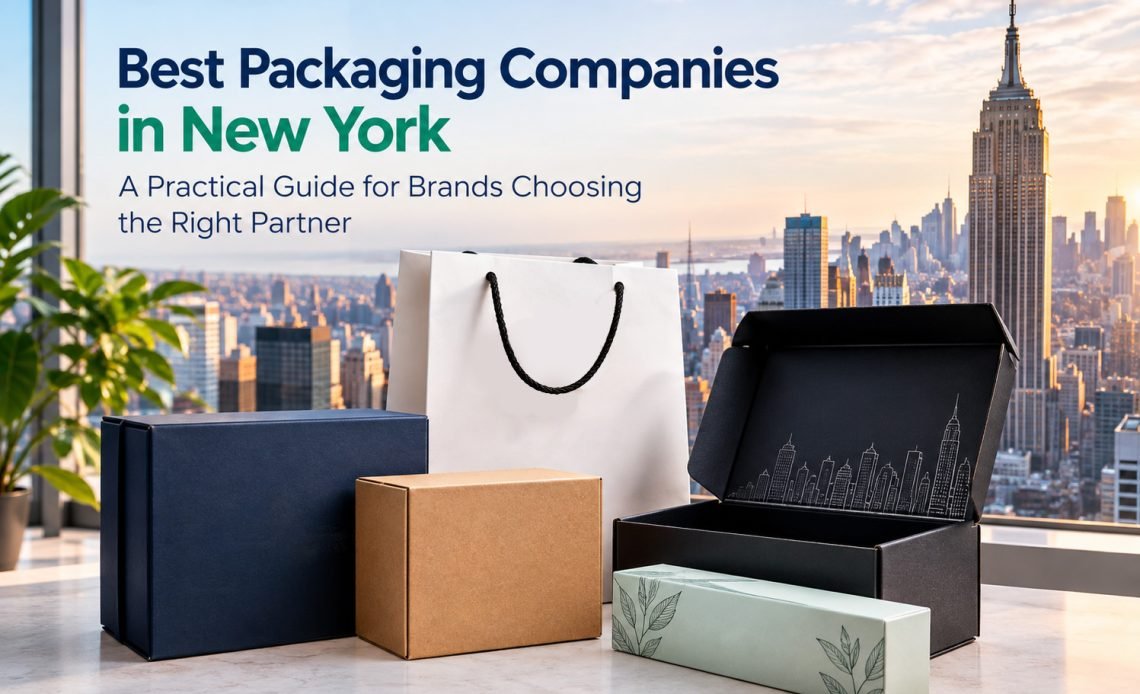
New York’s packaging market is as competitive and layered as every other industry sector the city hosts. A brand in the garment district sourcing retail packaging boxes has access to a dramatically different supplier landscape than a startup in Brooklyn looking for its first run of custom mailer boxes at 50 units, or a cosmetics company in Midtown negotiating with a design-led packaging agency for a range launch at Sephora. The city’s density, its role as the commercial headquarters for brands across fashion, beauty, food, consumer goods, and professional services, and its access to both domestic production facilities and global supply chain relationships make it one of the most active packaging procurement markets in the United States.
What it doesn’t make is a simple market to navigate. The packaging companies operating in and around New York vary enormously in what they actually do, what scale they serve, what their production capabilities include, and what the right choice looks like depending on the specific requirements of the brand making the decision. A brand that picks a packaging design agency when they need a manufacturer, or a high-volume offshore supplier when they need a low-minimum domestic run, has made a mismatch that costs them time and money regardless of the individual company’s quality.
This guide covers the packaging companies operating in New York that serve the most commercially significant buyer needs, what each specializes in, and the criteria that determine which type of supplier fits which type of brief.
What to Understand About New York’s Packaging Company Landscape
Before evaluating individual companies, understanding what categories of packaging company operate in New York clarifies why the market appears larger and more confusing than it needs to be.
The first category is packaging design agencies. These firms handle the creative and structural design of packaging without manufacturing it themselves. They develop the brief, the visual identity, the structural engineering, and the pre-production files that a manufacturing partner then produces. New York has a strong concentration of these agencies because the city’s density of brands requiring professional packaging design creates sustained commercial demand.
The second category is end-to-end custom packaging manufacturers. These companies handle both design and production, taking a brief from concept through to finished packaging delivered to the brand’s warehouse. They typically work with brands whose requirements are defined enough to specify what they need and whose volume supports custom production economics.
The third category is brokers and sourcing intermediaries. These companies manage relationships with offshore production facilities and provide brands with access to offshore manufacturing at lower minimum orders and lower per-unit costs than direct offshore sourcing requires, without requiring the brand to manage international supply chain logistics themselves.
The fourth category is commodity packaging suppliers. These companies supply standard packaging formats including corrugated shippers, folding cartons, and mailers in stock configurations without the custom print, finish, and structural design capability that branded packaging requires.
Most packaging decisions in New York involve the second or third category, and the distinctions between them matter for lead time, minimum order quantity, quality control access, and the type of design support available during the development process.
Zen pack

Zenpack operates from Long Island City in Queens with additional offices in San Jose and production relationships in China and Taiwan, positioning itself as an end-to-end custom packaging company covering structural engineering, graphic design, manufacturing, and fulfilment under one roof.
Its client list includes Google, Crown Affair, and Hennessy, reflecting a capability range that spans technology product packaging, premium beauty, and luxury consumer goods. Zenpack’s New York office is located at 28-07 Jackson Ave, 5th Floor, Long Island City, NY 11101, and the company offers premium rigid boxes, folding cartons, corrugated shippers, moulded pulps, thermoform trays, foam inserts, and fabric bags and pouches alongside a range of sustainable material options including ocean plastic textiles, washable kraft paper, biodegradable trays, and FSC certified cardboard.
The company’s process covers brand alignment, cost, and timeline roadmaps, prototype development, tooling-ready files, calibrated colour targets, QC plans, and kitting and assembly for retail and DTC channel compliance.
Zenpack is well suited to brands whose packaging brief requires design-led structural innovation alongside manufacturing, whose budget accommodates the premium positioning the company’s process implies, and whose volume supports the minimum orders that custom structural engineering and tooling require. It is less suited to brands whose primary requirement is low-minimum custom print packaging in standard structural formats, where Zenpack’s end-to-end design-engineering model adds process steps and cost that a simpler brief doesn’t justify.
Aly Packaging

Aly Packaging operates from 1140 Avenue of the Americas, 9th Floor, in Midtown Manhattan, giving it a New York City headquarters whose location in one of the city’s primary commercial corridors places it in physical proximity to the brand and agency relationships that drive custom packaging demand across fashion, beauty, cosmetics, food, retail, and consumer goods.
The company manufactures custom packaging across a wide product range including mailer boxes, rigid boxes, display boxes, popcorn boxes, retail packaging, hanging tab boxes, candle boxes, cosmetic packaging, die cut boxes, and folding cartons, with production starting from 25 units across most product categories. This low minimum order quantity is one of the more commercially significant practical details for brands at any stage of development, because 25 units is a quantity at which a brand can test packaging quality, assess print accuracy, verify structural performance, and confirm market response without committing to the inventory investment that higher minimum orders require.
Turnaround time runs at 8 to 10 business days for standard production, with a 6 to 8 business day rush option for time-constrained projects. The company provides digital proofs before production on all orders, artwork support for brands without production-ready design files, and guided specification recommendations for buyers who know what they need functionally but haven’t previously translated that into a technical packaging brief.
The combination of New York headquarters, low starting quantities, domestic-speed turnaround, and product range breadth makes Aly Packaging particularly suited to brands at the growth and scaling stage whose packaging requirements span multiple product categories and whose development cycles benefit from low-risk trial quantities before committing to larger production runs. Brands who want a single supplier relationship covering diverse packaging formats, whose brief prioritises speed and flexibility alongside quality, and whose volume ranges from initial trial quantities through to commercial-scale production will find the specification in this combination that most other New York packaging companies serve only partially.
Contact Aly Packaging at sales@alypackaging.com or call 1-844-259-7225 to discuss your packaging requirements.
Packaging NYC
Founded in 2015 by printing industry veteran Eric Causey, Packaging NYC is a custom packaging box provider operating from New York City, covering retail boxes, rigid packaging, food packaging, cosmetic boxes, and mailer boxes across its standard range. The company offers customisation including Pantone colour matching, CMYK and spot colour printing, gold, silver, and copper foiling, and embossed and debossed finish options.
Packaging NYC serves e-commerce businesses, startups, and retailers whose brief is custom branded packaging in established structural formats rather than structural innovation from scratch. Its printing industry background makes it appropriate for brands whose primary requirement is print quality and colour accuracy on standard folding carton and rigid box formats.
The company’s minimum order quantities vary by product and are communicated during the quoting process rather than published as fixed figures, which means brands with very low quantity requirements or very specific minimum order expectations should confirm these during the initial enquiry rather than assuming alignment with their specific volume.
Prime Packaging
Located in Brooklyn, Prime Packaging has been operating for almost 50 years and serves clients across retail, Amazon selling, and related commercial markets. The company specialises in plastic bags, custom die cuts, and personalised packaging solutions, and positions itself as staying ahead of packaging trends to meet growing client demand.
Prime Packaging’s nearly five-decade operating history gives it a different market position from newer entrants, reflecting sustained commercial relationships across New York’s retail and manufacturing base rather than the growth-stage positioning that more recently founded competitors occupy. Its specialisation in plastic bags and die cuts makes it more appropriate for operational packaging applications than for branded retail presentation packaging where premium finishes and structural design differentiation are the primary brief requirements.
How to Choose the Right Packaging Company in New York for Your Specific Brief
The framework for choosing between New York’s packaging companies reduces to four questions whose answers point toward a specific supplier type more reliably than general reputation assessments or review counts do.
The first question is whether your brief requires structural design innovation or packaging in established structural formats. If your product requires structural engineering from scratch, an end-to-end design-plus-manufacturing partner like Zenpack is the appropriate match. If your product requires custom print and finish in standard box formats, a manufacturer whose capability is production quality and print accuracy rather than structural innovation is the more efficient match.
The second question is what your minimum viable quantity is for a first order. Suppliers with minimum orders in the hundreds of units are appropriate for brands who have validated their packaging requirements and are ready to commit to production volume. Suppliers offering quantities starting from 25 units are appropriate for brands who are still in the validation phase or whose demand is inherently modest.
The third question is what your lead time requirement is. Offshore production through brokers or direct sourcing typically produces lead times of eight to fourteen weeks including sea freight, customs clearance, and domestic delivery. Domestic production typically produces lead times of one to three weeks from artwork approval. The gap between these timelines affects launch planning, reorder cycle management, and the risk of stockout between production runs in ways that the per-unit cost difference between offshore and domestic doesn’t capture when viewed in isolation.
The fourth question is whether you need a supplier who handles multiple product categories or one who specialises in a specific format. A brand packaging products across multiple categories, from shipping mailers through to retail display boxes to rigid gift boxes, benefits from a supplier relationship that covers all three without requiring separate supplier relationships, separate artwork handoffs, and separate quality management processes for each category. A brand whose entire packaging requirement is a single product format benefits less from multi-category supplier breadth and more from format-specific production expertise.
What the New York Packaging Market Is Getting Right in 2026
The New York packaging market reflects several of the broader packaging industry developments whose commercial significance has been building over the past several years and whose practical implications for brands choosing packaging suppliers are worth understanding as context for supplier assessment rather than simply as background information.
Sustainability requirements from major retail buyers have moved from aspirational to operational in the New York market more quickly than in many other US regional markets because New York’s concentration of sophisticated retail buyers, including the headquarters of national and international retail chains, has created a buyer community whose sustainability packaging requirements are specified rather than implied. Brands whose packaging doesn’t meet these requirements face ranging conversations that create commercial pressure to update packaging specifications regardless of the brand’s own sustainability priorities.
Low minimum order quantities have become a meaningful competitive differentiator in the New York custom packaging market as the city’s startup and scale-up brand community has grown in scale and sophistication. A packaging market that served primarily established brands at established volumes has adapted to a buyer community whose requirements start small and scale, and the suppliers who have adapted their production models to serve this buyer profile have grown while those who haven’t have found their accessible market narrowing.
Domestic production speed has become a competitive advantage against offshore sourcing for a portion of the New York buyer market that the extended lead times and supply chain disruption experiences of 2020 to 2023 permanently shifted toward valuing supply chain reliability over per-unit cost optimisation. This shift has benefited domestic and domestically-managed production relationships over pure offshore sourcing, particularly for brands whose product launches and seasonal restocks have fixed calendar commitments that offshore lead time variability puts at risk.
