


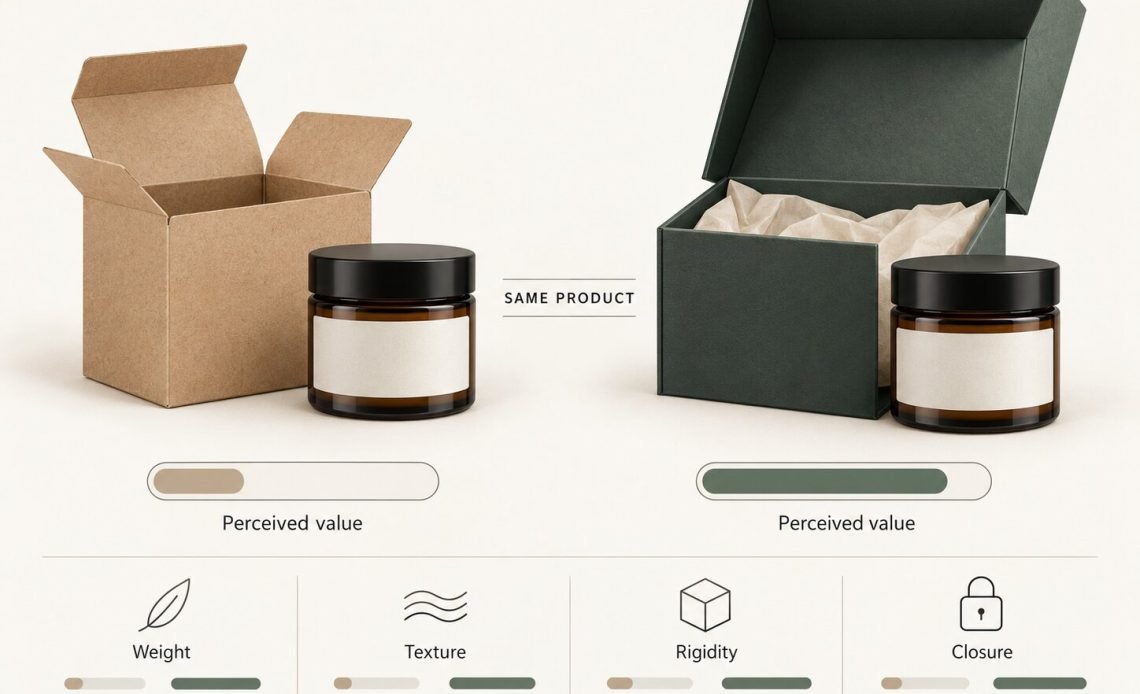
Pick up two identical products. Put one in lightweight folding carton packaging and the other in a rigid box with a magnetic closure, soft-touch lamination, and interior tissue. Ask a group of consumers which product is worth more. The answer will be the rigid box, consistently, across every category where this experiment has been run, by margins that are large enough to affect purchase decisions and pricing strategy rather than simply reflecting aesthetic preference.
This outcome is documented in enough independent research to be treated as a reliable commercial mechanism rather than an interesting anomaly. A product in premium packaging is perceived as 32 to 45 percent more valuable than the identical product in economy packaging. When marketing researchers analyzed 1,353 products on the shelves of the largest supermarket chain in the United States, the packages carrying the higher prices were, on average, the plainer ones, suggesting that even restraint can communicate premium when executed with precision. A 2025 study in Scientific Reports showed that a more involved unboxing experience measurably raised how attractive and premium a product felt, with texture shaping the entire sensory experience of what was inside, even though the product never changed.
The mechanism behind these outcomes is structural rather than decorative, and understanding it changes how packaging investment decisions are made.
Why Does the Brain Process Packaging Before the Label?
The neurological sequence of product evaluation places structural and material cues ahead of printed information in the processing hierarchy, which is why packaging structure influences value perception before any label is read or any claim is processed.
Your brain processes material cues faster than it processes logos or pricing. Neuroimaging studies show that touching a textured, dense surface activates the insula and orbitofrontal cortex, regions tied to reward and value assessment, within 100 to 200 milliseconds. This processing happens below conscious awareness, which means the value judgment that structural packaging creates is already formed before the conscious mind begins evaluating the product’s claims, price, or brand narrative.
The practical commercial consequence of this neurological sequence is that packaging structure creates a value baseline that everything else is measured against rather than a neutral container within which product quality communicates independently. A premium product in inadequate structural packaging is being evaluated against a value baseline whose floor is set by the packaging before any product quality signal has been assessed. A mid-range product in carefully specified structural packaging is being evaluated against a value baseline whose floor is set by the packaging material and construction quality in ways that systematically support higher price perception than the product’s functional attributes alone would generate.
What Structural Properties Create the Perception Gap
The physical properties of packaging whose presence or absence most reliably determines whether a product feels more or less expensive than it is are specific enough to be directly actionable in specification decisions.
Weight is the most consistently documented structural property in value perception research. Research shows that a product held in heavier packaging is rated as more effective, more premium, and worth more money, even when the product inside is identical to one in lighter packaging. This weight-value association reflects a learned heuristic developed through repeated physical experience with dense, heavy materials in contexts where density and weight genuinely correlate with quality and durability. The brain applies this heuristic automatically to packaging, which means heavier board grades, denser rigid box construction, and weighted closures all create value signals whose strength is proportional to their departure from the lightweight default.
Texture is the second structural property whose value perception contribution is documented with specific data. A choice-based study of 400 consumers on cosmetic packaging found that velvety soft-touch lamination held its appeal even when it added 5 percent to the price, with people valuing the feel enough to pay for it. The tactile quality that soft-touch lamination creates operates on the same neurological pathway as weight, activating reward-associated regions in the brain through the physical experience of handling the packaging surface before any label is read or product examined.
Structural rigidity communicates value through the resistance to deformation that rigid construction creates. A box that holds its shape under grip pressure communicates manufacturing precision and material quality through its structural response to handling rather than through any visual signal. Packaging that flexes under hand pressure communicates the opposite regardless of its print quality or design sophistication, because the structural response communicates manufacturing standard in ways that printed elements can’t override.
Closure mechanism quality creates a specific value signal at the highest-attention moment of product interaction, the point immediately before the product is revealed. Angular shapes and more complex packaging interactions, such as sliding or tilt-opening mechanisms, have been found to evoke more intense taste sensations and lead to higher price expectations. A magnetic closure that snaps shut with quiet authority communicates engineering precision. A tuck closure that engages loosely communicates cost minimisation. This closure quality signal operates at the moment when emotional engagement with the product is at its peak, making it commercially disproportionate in its value perception contribution relative to its cost within the total packaging specification.
How Packaging Structure Enables Pricing That Product Quality Alone Cannot Support
The commercial application of structural packaging value perception extends beyond making products feel premium into the specific mechanism through which packaging structure enables price points that product functional quality alone cannot sustain.
Premium packaging allows brands to justify a higher price point. Consumers associate the quality of the packaging with the quality of the product inside. This psychological link enables brands to charge a premium of 10 to 30 percent more compared to competitors with basic packaging. This premium operates not through consumer deception but through genuine value delivery: the packaging experience is part of the product experience, and consumers are paying for and receiving something real when packaging quality is high.
The price premium mechanism is most commercially significant in categories where product functional differentiation is difficult to perceive or communicate directly. A consumer evaluating two skincare products with similar active ingredient profiles and similar price points has limited functional differentiation information to work with. The packaging structure becomes the primary differentiating quality signal, and the product whose packaging communicates more premium structural quality commands higher price acceptance not because the consumer is fooled but because the packaging’s physical quality is a genuine product attribute that distinguishes it from the alternative.
The inverse mechanism matters equally. A genuinely superior product in packaging whose structural quality communicates below its actual quality level is systematically underpriced relative to its value because consumers won’t pay what they don’t perceive, and the structural packaging signals they receive don’t support the price the product’s functional quality warrants. Premium product quality packaged in economy structural quality creates a value perception mismatch that prices the product below its actual worth regardless of the brand’s pricing intent.
Why Simplicity Sometimes Outperforms Decoration
One of the less intuitively obvious findings in packaging value perception research is that structural simplicity with material precision frequently outperforms decorative complexity in creating premium value signals, particularly in consumer segments whose category experience has developed the reference framework to distinguish between genuine quality and its approximation.
When marketing researchers analysed 1,353 products across a major US supermarket chain, packages carrying higher prices were on average the plainer ones. Consumers shown a hand cream in plain packaging were willing to pay more for it than for the identical cream wearing a printed geometric pattern. This simplicity premium reflects a specific mechanism: decorative complexity communicates effort, while structural precision communicates confidence. Products in simple, precisely specified packaging communicate that the brand is confident enough in its quality not to explain it through visual elaboration.
This simplicity-value relationship has particular relevance for brands whose packaging investment decisions frame the choice as more decoration versus less decoration rather than as better structural precision versus acceptable structural precision. Investing in board grade, closure quality, and surface material rather than in additional finishing effects frequently produces stronger value perception outcomes at equivalent or lower cost, because it targets the neurological mechanisms that create value judgments rather than the decorative elements that conscious evaluation processes after the value judgment has already been formed.
What Packaging Structure Cannot Do
The value perception created by structural packaging quality has a ceiling determined by product experience, and understanding this ceiling prevents the over-investment error of packaging specification that creates value expectations the product cannot fulfil.
Because the same chocolate was presented across all packaging conditions in multisensory packaging research, differences in price expectations reflected inferences anchored on packaging cues rather than changes in intrinsic product value. The structural packaging created a value expectation whose confirmation or violation occurred at the moment of product consumption. Packaging that creates a value expectation the product confirms generates the satisfaction that drives repeat purchase. Packaging that creates a value expectation the product fails to confirm generates the disappointment that prevents it.
The commercial optimum is a structural packaging specification that creates a value perception slightly ahead of the product’s functional quality rather than dramatically ahead of it. Slightly ahead because the packaging-created value expectation primes the product experience positively, making consumers more receptive to the product’s actual qualities. Dramatically ahead because the expectation gap creates a disappointment response that outweighs the conversion benefit the premium packaging generated in the first place. Finding this optimum requires honest assessment of where the product’s functional quality genuinely sits rather than where the brand’s aspiration places it.
What This Means for Packaging Specification Decisions
The research on packaging structure and value perception translates into specific specification priorities whose commercial return differs substantially between investment categories.
Board grade and construction weight deliver the highest return per pound of specification investment because weight is the most consistently documented value perception driver across the research literature, and board grade differences between lightweight and heavyweight production are modest in cost but significant in sensory output. Specifying upper-range board grades rather than minimum adequate grades for any product whose price point or positioning places value perception within the competitive equation is one of the highest-return specification decisions available.
Closure mechanism quality delivers disproportionate return because it creates its value signal at the moment of peak emotional engagement rather than during the initial shelf assessment where all other packaging elements compete for attention simultaneously. A magnetic closure specified at pull strengths that create a precise, quiet snap rather than the loose engagement of standard hardware costs modestly more per unit and produces a value signal that consumers remember and describe when asked about product quality.
Surface material selection, specifically the choice between lamination types whose tactile qualities differ, delivers measurable willingness-to-pay impact even at modest cost increments. Soft-touch matte lamination held its appeal even when it added 5 percent to the price in documented consumer research, meaning the tactile value signal the surface creates is real enough for consumers to pay for rather than simply appreciate when it’s free.
Structural simplicity with material precision beats decorative complexity with material adequacy in premium value signalling for most product categories outside those where visual abundance is the expected quality convention. Redirecting packaging specification investment from additional finishing effects toward higher material quality frequently improves both the value perception outcome and the specification economics.
