
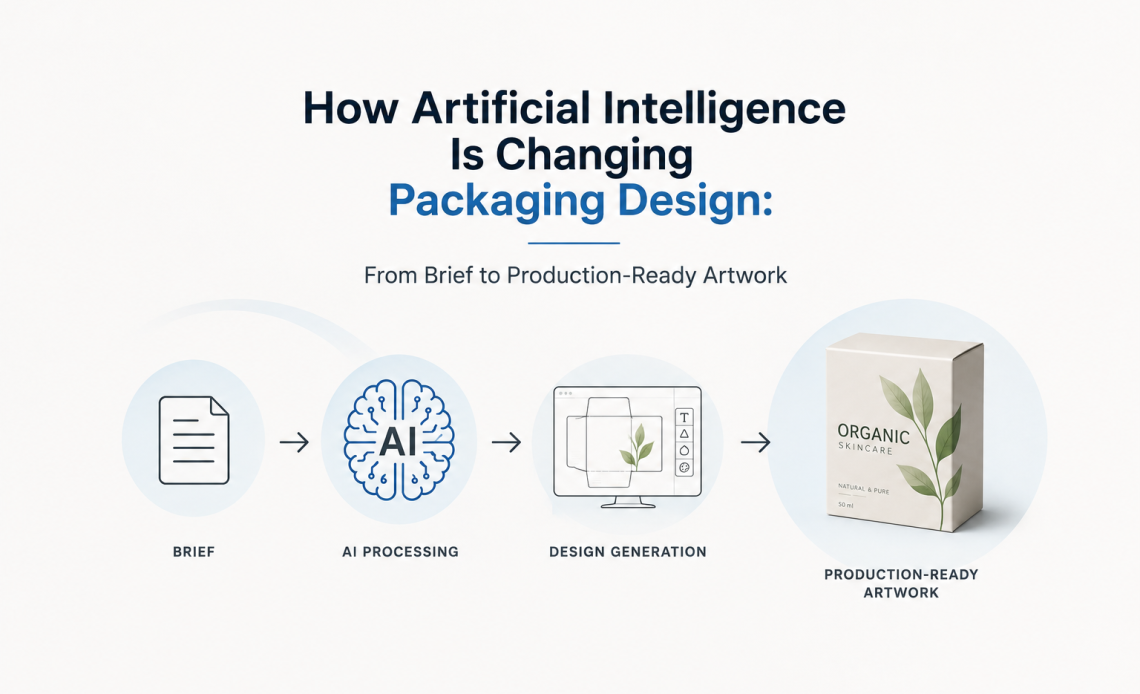
Packaging design has always been one of the more technically constrained creative disciplines. A brief arrives, concepts get developed, artwork gets refined, files go through prepress, then production. That cycle has been broadly consistent for decades, changing at the edges with new software and faster printing technology but not in its fundamental structure. Artificial intelligence is now changing that structure, not incrementally but in ways that affect almost every stage from the initial brief through to the file that arrives at the printer. Understanding what AI is actually doing to packaging design, and where the limits still are, matters more than the general noise around AI disruption suggests.
What Is AI Actually Doing in Packaging Design Right Now?
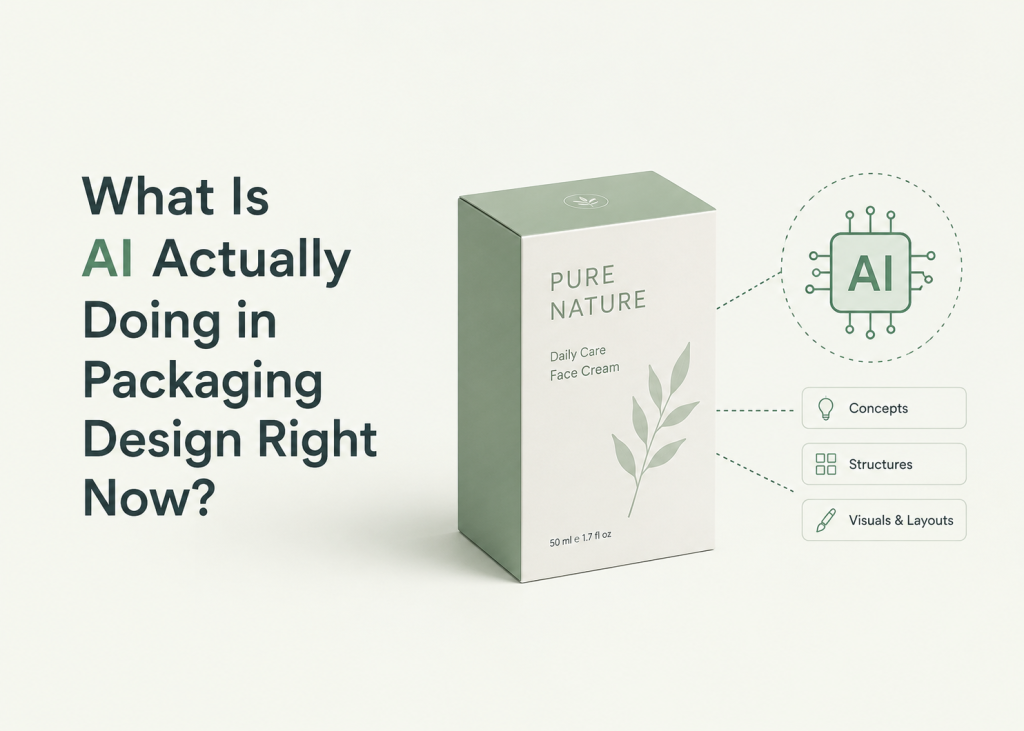
In 2026, AI in packaging design covers three distinct things that marketing language routinely conflates. The first is generative image creation, where tools like Midjourney, DALL-E, and Stable Diffusion produce visual concepts from text prompts. The second is AI-assisted layout and variant generation inside existing design software like Adobe Illustrator and Photoshop. The third is AI-assisted production workflow automation, including file validation, print-readiness checking, and variant scaling across SKUs and markets.
These three things are at very different stages of maturity. Generative image creation is sophisticated, fast, and genuinely useful for early-stage ideation. AI-assisted layout tools are evolving rapidly and already useful for repetitive production tasks. Automated workflow tools are the most commercially mature and are delivering the most measurable efficiency gains for brands managing complex packaging portfolios.
Can AI Generate a Complete Packaging Design From a Brief?
Partially, but not completely, and the gap between partial and complete matters enormously in practice. A text prompt describing a brand’s aesthetic, colour palette, and product category can produce dozens of visually compelling concept images in minutes. Where a human designer might develop three to five initial directions, an AI tool can produce thirty to fifty in the same time. This is genuinely useful at the exploration stage of a brief.
The problem appears immediately when those concepts need to become physical packaging. AI image generators produce visually appealing outputs with no structural validity. Panels don’t fold correctly. Bleed areas don’t exist. Dielines aren’t present. No manufacturer can print from a Midjourney output because Midjourney has no understanding that the image it has created represents a three-dimensional object that needs to unfold flat, be cut, folded, glued, and filled. The gap between an AI-generated concept image and a production-ready file is currently the entire technical discipline of packaging production. AI closes the front end of that gap. The back end remains a human responsibility.
Why Can’t AI Produce Print-Ready Packaging Files?
Because print-ready packaging files require structural accuracy that image generation tools don’t produce. A production-ready packaging file needs correct colour mode (CMYK, not RGB), Pantone spot colour callouts applied separately, proper resolution or vector format for all artwork elements, type outlined or supplied as fonts, a dieline on a separate layer indicating cut lines and fold lines, and correct bleed allowances around all edges.
AI image generators work in RGB and produce raster outputs without any of this production infrastructure. Pantone colour matching, which is critical for brand consistency across print runs, cannot be produced by generative AI and has to be applied during prepress in Illustrator or InDesign. The technical gap isn’t a software limitation that will close quickly. It reflects a fundamental difference between generating a visually compelling image and producing a file that specifies exactly how physical materials should be cut, folded, and printed to create a three-dimensional object.
Is AI Replacing Packaging Designers?
No, but it is reshaping which parts of a packaging designer’s work AI handles and which remain distinctly human. The industry consensus across practitioner communities is that AI is replacing junior production tasks, including moodboards, variant creation, background removal, basic retouching, and simple mockups, rather than the senior design judgment that determines what a brand should look like in the first place.
The skills that make packaging designers hard to replace, including brand strategy, structural problem-solving, cultural context, regulatory knowledge, and the ability to create work that genuinely connects with specific audiences, are exactly the skills AI cannot reliably produce. What AI is producing is an increase in the volume of competent concept generation that happens before senior designers make creative decisions. Designers who understand how to use AI tools to expand exploration without losing creative direction are becoming more valuable, not less. Designers who don’t are finding that the junior production roles where people used to learn the discipline are disappearing.
How Is AI Changing the Speed of Packaging Design?
Significantly. The most widely reported efficiency gain is in the ideation phase, where AI reduces the time between receiving a brief and having a broad visual direction from days to hours. Brands that previously ran three-week design exploration cycles report covering the same creative ground in three to five days when AI tools are integrated into the early stages.
Variant generation is the second area of measurable speed improvement. A brand managing packaging across multiple market regions, multiple SKU sizes, and seasonal variations previously managed artwork adaptation as a time-intensive manual process. AI-assisted variant tools can scale an approved design across formats, markets, and sizes automatically, maintaining brand consistency while reducing the manual work that would otherwise require significant designer time per variant. For brands with hundreds of active SKUs, this represents a genuine operational change rather than a marginal efficiency.
The third speed change is in 3D visualisation. Photorealistic shelf mockups that previously required either a 3,000 to 5,000 dollar 3D rendering engagement or a physical printed sample can now be produced in minutes using AI mockup tools. For early buyer presentations and stakeholder approvals, this removes a high cost and timeline from the design development cycle.
What Are the Real Limitations of AI in Packaging Design?
Several, and they’re worth understanding clearly rather than accepting the general hype that AI is transforming everything simultaneously.
Regulatory compliance is the most significant limitation in food, pharmaceutical, and personal care packaging. Nutrition facts panels, allergen declarations, ingredient lists, and warning language all require precise formatting, specific font sizes, mandatory content, and legal accuracy that AI tools cannot verify or guarantee. AI may generate a plausible-looking nutrition panel based on patterns in its training data. It may also generate one that is wrong in ways that create regulatory liability. Human expertise remains essential for any packaging element that carries legal or compliance requirements.
Brand consistency is harder to maintain with AI than the tools’ capabilities suggest. Without strict prompt engineering or custom-trained models built specifically on a brand’s existing assets, AI-generated packaging concepts drift from established brand identity in subtle ways that accumulate across a design programme. Almost right colour. Typography that’s approximately brand-aligned. Graphic style that references the brand without quite being it. These inconsistencies are manageable when AI is used for early-stage ideation. They become expensive problems when AI outputs are treated as finished creative direction without human editorial oversight.
Copyright and intellectual property are unresolved questions. AI image generators are trained on existing visual work, and the outputs they produce can, without deliberate prompt management, closely resemble existing packaging designs. The legal landscape around AI-generated design and IP is still developing, but brands using AI for commercial packaging design need to understand the exposure before assuming the output is safe to use.
How Are Packaging Agencies Integrating AI Into Their Workflows?
The agencies demonstrating consistent value from AI tools have restructured their workflows around a pattern that distinguishes where AI contributes from where human expertise is non-negotiable. AI handles early-stage concept explosion, producing large volumes of visual starting points quickly. Senior creative direction then curates and develops the strongest concepts, making the brand strategy and design quality decisions that AI cannot make. AI-assisted compliance and print-readiness checking runs before files are finalised, catching technical issues early. Automation then scales approved designs across formats and markets without proportional increases in manual effort.
This pattern treats AI as a tool that expands what designers can explore and automates what is genuinely automatable, rather than as a replacement for creative judgment or technical expertise. The agencies that have tried to use AI to reduce senior design time rather than expand junior production capacity have generally found the results inconsistent and the cost savings offset by revision cycles.
Does AI Affect Packaging Cost?
In some areas, meaningfully. The reduction in physical sampling required for concept approval is one of the clearest cost impacts. AI-generated 3D mockups replace a portion of the physical prototype production that previously happened at the concept review stage. Brands that made packaging decisions after reviewing physical samples now frequently make early-stage decisions after reviewing photorealistic renders, reserving physical samples for the final approval step.
The cost reduction in variant management is significant for brands managing large packaging portfolios. Manually adapting a packaging design across ten regional market requirements, eight size variants, and four seasonal colourways previously required substantial design time. AI-assisted variant tools handle much of this adaptation automatically, reducing both cost and error rate.
Where AI doesn’t reduce packaging cost is in production itself. The print process is indifferent to whether AI was involved in creating the artwork. What matters at the production stage is whether the file is print-ready, and print-readiness still requires human expertise to ensure. Brands that assume an AI-generated concept can go directly to production without a professional prepress step discover the limitation of that assumption through costly reprints or press-side corrections.
What Does AI Mean for the Brief-to-Artwork Timeline?
The timeline is compressing, but not uniformly across all stages. Early ideation that previously took two to three weeks now happens in two to three days with AI tools integrated into the exploration phase. Physical sample production timelines haven’t changed because they’re determined by printing and manufacturing processes that AI doesn’t affect.
The prepress and artwork preparation stage, which sits between approved design and production-ready file, remains approximately as time-intensive as it was before AI became part of the upstream process. The mistake brands sometimes make is assuming that faster ideation means faster production, when in reality the speed gains are concentrated at the front of the design process and the production preparation requirements remain the same.
The net effect for most brands is a shorter total design development cycle, particularly for complex projects requiring extensive concept exploration, and a more efficient variant management process once a design direction is approved. The efficiency doesn’t eliminate the need for professional design and production expertise. It shifts where that expertise is most critical, away from volume production tasks and toward the creative and technical judgment decisions that determine whether packaging actually works.
