


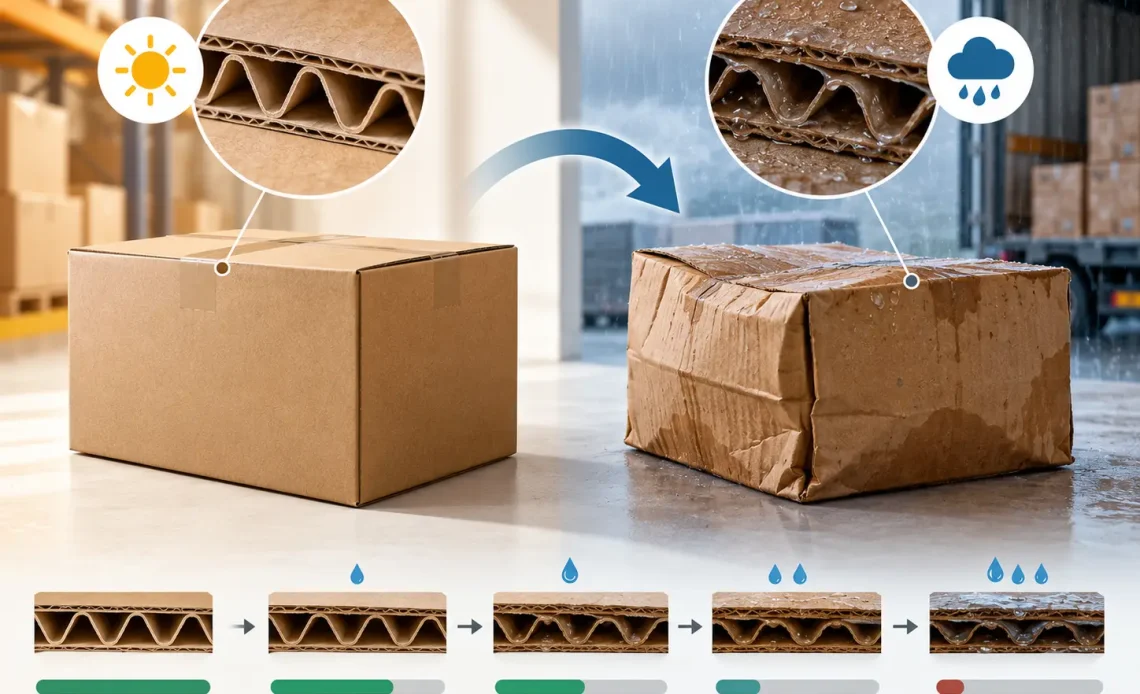
A corrugated box that passed its specification tests with comfortable margins when it left the manufacturing facility can arrive at a retail distribution centre or warehouse as a structurally compromised container whose stacking strength is a fraction of what the specification said it would be. No quality control failure occurred. No production error created the gap between the tested specification and the delivered performance. The box simply spent time in an environment whose humidity absorbed into its paperboard fibres, changed its material properties, and reduced its compression resistance in ways that the testing environment didn’t replicate.
This is the humidity problem in corrugated packaging, and it is more commercially significant than the packaging industry’s standard testing framework typically communicates to the buyers using corrugated containers for distribution. Standard corrugated board testing occurs at the TAPPI T 402 conditioning standard of 50 percent relative humidity at 73.4 degrees Fahrenheit. This is the laboratory baseline at which ECT, burst strength, and box compression test values are measured and reported. It is not the humidity that corrugated boxes experience during the storage and transit conditions of real distribution, which routinely exceed 50 percent and in some environments and seasons substantially exceed it.
Understanding what humidity does to corrugated packaging strength as a function of the actual humidity levels encountered in storage and transit, rather than the controlled levels at which packaging is tested, changes how specification decisions are made and what operational practices protect packaging performance through the distribution chain.
What Happens to Corrugated Board When Humidity Rises
Corrugated board is a composite material whose structural performance depends on two systems working together: the mechanical properties of the paperboard fibres in the liner and medium layers, and the adhesive bond between those layers at the flute tips. Humidity affects both systems simultaneously and in reinforcing ways whose combined effect on stacking strength is substantially larger than either effect in isolation.
Above a relative humidity of 30 percent, paper fibres are affected, resulting in a decrease in the top-to-bottom compression strength of corrugated boxes. The mechanism is straightforward: cellulose fibres in paperboard are hygroscopic, meaning they absorb water molecules from the surrounding atmosphere when ambient humidity exceeds the moisture content of the fibres themselves. As moisture content rises, the hydrogen bonds between cellulose chains weaken, reducing the fibres’ resistance to deformation under load. A fibre that resists compression in dry conditions yields progressively more easily as its moisture content increases.
The adhesive system compounds this problem. Corrugated board layers are bonded with starch-based adhesive, typically corn starch, whose moisture resistance in its standard formulation is limited. At elevated humidity, starch adhesive absorbs moisture and softens, weakening the bond between liner and medium at flute tip contact points. As the fibres soften and the starch-based adhesives weaken, box walls and flutes lose the rigidity that gives them their compressive strength. The corners, which bear roughly two-thirds of a box’s total compression load, become especially vulnerable.
The result of these simultaneous mechanisms is a compression strength reduction that follows a non-linear relationship with humidity increase. At 50 percent relative humidity, a corrugated box is at approximately 80 percent of its potential stacking strength under ideal conditions. At 85 percent relative humidity, a box has roughly 50 percent of its potential stacking strength. An increase in relative humidity from 40 to 90 percent can result in a loss of about 50 percent of a corrugated container’s stack strength. As ambient relative humidity increases past 95 percent, stacking strength can decrease by more than 60 percent.
How ECT and Compression Strength Respond Differently to Humidity
The relationship between humidity and corrugated board strength is not uniform across all measured mechanical properties, and understanding which properties are most sensitive to humidity change is important for specification decisions that account for real-world humidity exposure.
ECT strength appears to be the most sensitive to changes in temperature and humidity among the mechanical properties of corrugated board. The edge crush test measures the resistance of the corrugated board to compression along its edge, which is the measurement most directly relevant to the box’s column stacking strength when boxes are loaded in a pallet stack. As ECT strength is the measurement most used for corrugated specification, its being the property most sensitive to humidity means that the specification value a buyer is working from is the value most aggressively degraded by the humidity conditions the packaging will actually encounter.
Tensile strength, which measures the resistance of the board to being pulled apart, decreases with increasing relative humidity in both the machine and cross directions. The cross-direction tensile strength reduction under humidity is particularly relevant for box constructions whose performance under lateral forces during transit depends on cross-direction paper strength. Transit vibration and impact create lateral forces on box walls that combine with stacking compression in ways whose total effect on already humidity-weakened board exceeds what either force alone would produce.
Bending stiffness, shear stiffness, and torsion stiffness all decrease with increasing relative humidity, with research across 43 different temperature and humidity condition combinations consistently showing that higher relative humidity produces lower mechanical property values across all measured parameters. The research results clearly show that with increasing relative humidity, tensile strength of paper decreases in both the machine and cross directions, and that higher relative humidity and lower temperature resulted in lower strength of the box by up to 60 percent.
The Time Dimension: Why Humidity Damage Accumulates During Storage
The compression strength reduction that humidity produces in corrugated boxes is not instantaneous. It develops progressively as moisture penetrates through the board layers from exposed surfaces toward the board core, a diffusion process whose rate depends on the humidity differential, the board’s initial moisture content, the basis weight of the liners and medium, and the presence or absence of any moisture-resistant coatings or treatments.
A stack that holds up for a day or two during staging may not hold up over two weeks of extended storage, especially when humidity is involved. This time-dependent accumulation of humidity damage creates a specific risk in distribution systems whose storage durations are variable or difficult to control. A packaging specification calibrated for the compression load of a fully stacked pallet whose storage duration is two to three days is a different specification requirement from one calibrated for the same pallet held in distribution centre storage for two to three weeks. The cumulative moisture penetration over two to three weeks at elevated ambient humidity produces board properties substantially below the two-to-three day profile even at identical ambient humidity levels.
The box location within a pallet stack interacts with storage duration in ways that compound the humidity risk for specific positions. Boxes at the bottom of the stack carry the compression load of every box above them while simultaneously being the furthest from any air circulation that might reduce local humidity levels. High-humidity environments as commonly encountered in warehouses with uncontrolled summer climate obviously weaken boxes, and the bottom positions in unconditioned warehouse pallet stacks combine maximum humidity exposure with maximum compression load in the configuration that produces the earliest and most severe compression failures.
Transit Humidity Exposure: What Actually Happens Inside a Delivery Vehicle
The transit environment inside freight vehicles creates humidity exposure conditions that storage specifications don’t always account for because the vehicle interior humidity can differ substantially from both the origin storage environment and the destination storage environment in ways that are difficult to predict or control.
Temperature cycling between a climate-controlled storage facility, a heated loading dock, and the interior of a freight vehicle during winter or a non-air-conditioned vehicle during summer creates condensation events whose liquid water contact with corrugated board produces damage rates dramatically faster than ambient humidity absorption. Humidity weakens corrugated gradually and silently, and by the time a box shows visible distress the structural damage is already done. Liquid water destroys corrugated board almost immediately. The condensation that forms on cold box surfaces when they are moved from refrigerated storage to ambient loading dock environments represents liquid water contact rather than ambient humidity exposure, and its structural consequences are correspondingly more severe and faster-acting than the gradual humidity absorption that extended ambient exposure produces.
The mixed cargo conditions in many freight vehicle loads create local humidity environments whose variation from the vehicle’s average interior humidity can be significant. Produce, fresh food, refrigerated items, and other moisture-generating cargo in the same vehicle increases local humidity around adjacent packages in ways that packaging specifications developed in isolation from cargo environment don’t account for. The corrugated box shipped alongside refrigerated produce in a mixed-temperature freight load experiences a more aggressive humidity environment than the vehicle’s average interior conditions suggest.
What Specification Decisions Compensate for Humidity Exposure
The practical response to humidity’s effect on corrugated compression strength is available through several specification pathways whose effectiveness and cost profiles differ in ways that make the best choice application-dependent rather than universal.
Basis weight increases in the liner and medium layers are the most established response to humidity-driven strength loss. Box design for high humidity conditions requires compensation for the resulting strength loss, usually by producing boxes with higher basis weight. An increase in liner basis weight adds physical material whose absolute strength before moisture exposure is higher, preserving an adequate post-exposure strength after the humidity-driven reduction has occurred. The limitation of this approach is that basis weight increases add material cost and box weight that compounds dimensional weight freight cost, making it a solution whose total cost needs to include both the material premium and the freight premium.
Moisture-resistant adhesive formulations address the adhesive degradation component of humidity-driven strength loss without requiring basis weight increases. Standard corn starch adhesives can be replaced or modified with moisture-resistant formulations that maintain bond strength under humidity exposure significantly better than standard adhesives, preserving the structural integrity between liners and medium that contributes to compression strength alongside the fibre properties of the board itself.
Moisture-resistant coatings and treatments applied to the liner surfaces reduce the rate of moisture penetration from exposed box surfaces into the board core, extending the time before ambient humidity reaches the board interior and reducing the total moisture uptake over a given exposure duration. Surface coatings don’t eliminate humidity-driven strength loss but they slow it, which for applications whose humidity exposure is duration-limited rather than extended provides meaningful performance improvement at modest cost.
Specifying boxes at higher ECT ratings than the McKee formula’s minimum for the product weight and box perimeter provides a strength margin that compensates for the ECT reduction that humidity exposure produces. A box whose as-tested ECT exceeds the minimum required by 20 to 30 percent retains adequate compression strength after humidity-driven ECT reduction that would bring a minimum-specification box below its required performance.
What Operational Practices Reduce Humidity-Driven Packaging Failure
Specification decisions address what goes into the box. Operational practices address what happens to the box after it leaves manufacturing, and both dimensions together determine whether corrugated packaging performs through the full distribution cycle rather than failing before its product reaches its intended destination.
The starting point is storage before use. Corrugated packaging and dunnage that sits in an unconditioned warehouse or on an open dock before it is ready to be used is already absorbing humidity and losing strength before any product has been loaded or any transit has begun. Storing corrugated materials in climate-controlled areas prior to use preserves the rated performance of the board. This operational step costs nothing beyond the space allocation it requires and prevents the pre-loading strength loss that compounds with in-transit and in-storage exposure.
Pallet condition and load distribution interact with humidity-weakened corrugated in ways that amplify failure risk beyond what either factor creates independently. A corrugated box’s ability to resist stacking loads depends partly on how well it is supported from below. Damaged or irregular pallet surfaces create uneven support that concentrates compression load at specific points on the base panel rather than distributing it across the full panel area. At standard humidity, a well-engineered box specification accommodates modest pallet surface irregularities within its strength margin. At elevated humidity, the same specification’s reduced strength margin provides less tolerance for pallet-induced load concentration, making pallet condition a more consequential variable in humid environments than in controlled humidity conditions.
Stack height reduction during humid season storage is the operational response to humidity-driven strength reduction whose implementation requires no specification change and no additional material investment. If a box retains 50 percent of its stacking strength at 85 percent relative humidity, reducing stack height by 50 percent during humid season storage periods maintains the same safety factor as the full stack height at standard humidity. The operational cost of this adjustment is increased storage footprint whose expense should be weighed against the distribution damage cost that maintaining standard stack heights in humid conditions would generate.
