


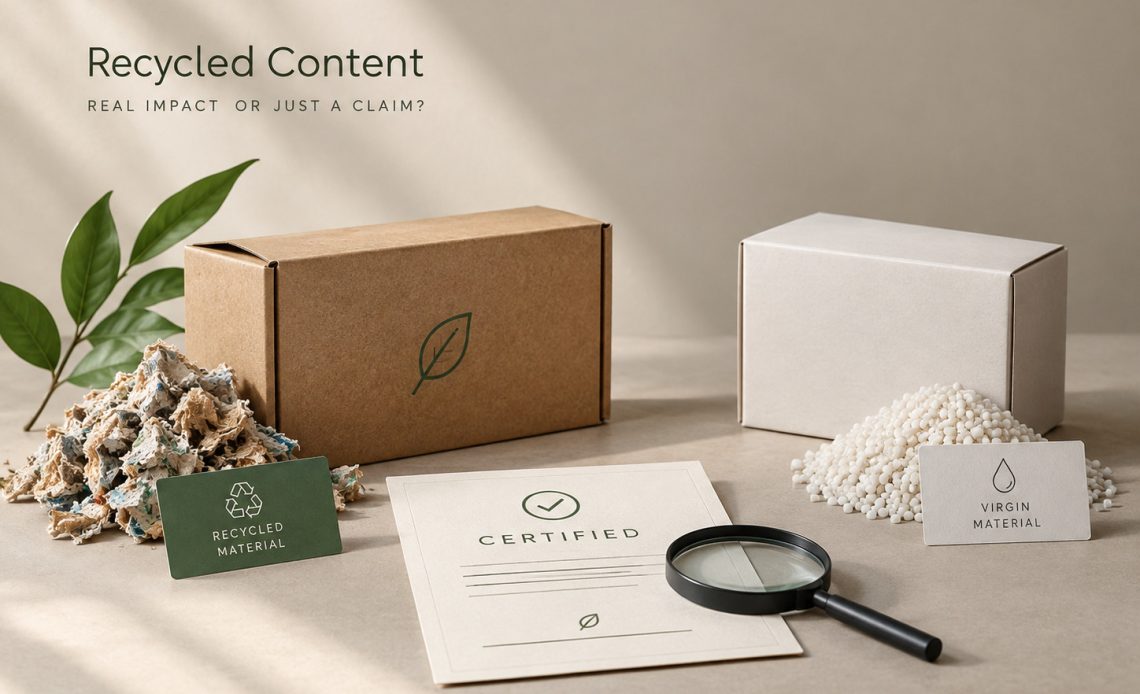
The phrase recycled content appears on packaging with enough frequency to have lost most of its informational value. It appears on paper bags, plastic pouches, cardboard mailers, and rigid boxes across categories whose environmental credentials vary from genuinely impressive to barely distinguishable from conventional production. The phrase itself doesn’t tell you whether the recycled content is post-consumer material that was actually recovered from the waste stream or manufacturing offcuts that never reached a consumer in the first place. It doesn’t tell you what percentage of the packaging is actually recycled content versus the percentage that is virgin material. It doesn’t tell you whether anyone other than the brand’s marketing team has verified the claim. And it doesn’t tell you whether the claim was accurate when it was printed or whether the supply chain that supported it is still intact.
The gap between what recycled content claims imply and what they prove has created a verification problem that has moved from a niche sustainability concern into a mainstream commercial and regulatory issue. Reynolds Consumer Products paid $212,000 to Arizona over Hefty bags marketed for recycling that were never recyclable. The FTC charged paper manufacturer AJM Packaging with making biodegradable and recyclable claims it could not substantiate. A 2025 class action accused Amazon of greenwashing its FSC-marked paper products tied to clear-cut Canadian boreal forests. France’s JEP ruled against multiple consumer goods brands for using sustainable packaging labels without specific metrics and ordered removal of the claims from packaging. These aren’t fringe cases. They’re a pattern whose frequency reflects how common unsubstantiated recycled content claims have become across the packaging market.
Understanding how to tell genuine recycled content from a marketing claim matters for brands whose packaging suppliers are making claims they need to rely on, for buyers whose purchasing decisions are influenced by recycled content claims, and for brands whose own packaging makes claims they may not have verified adequately.
What Is the Difference Between Post-Consumer and Post-Industrial Recycled Content?
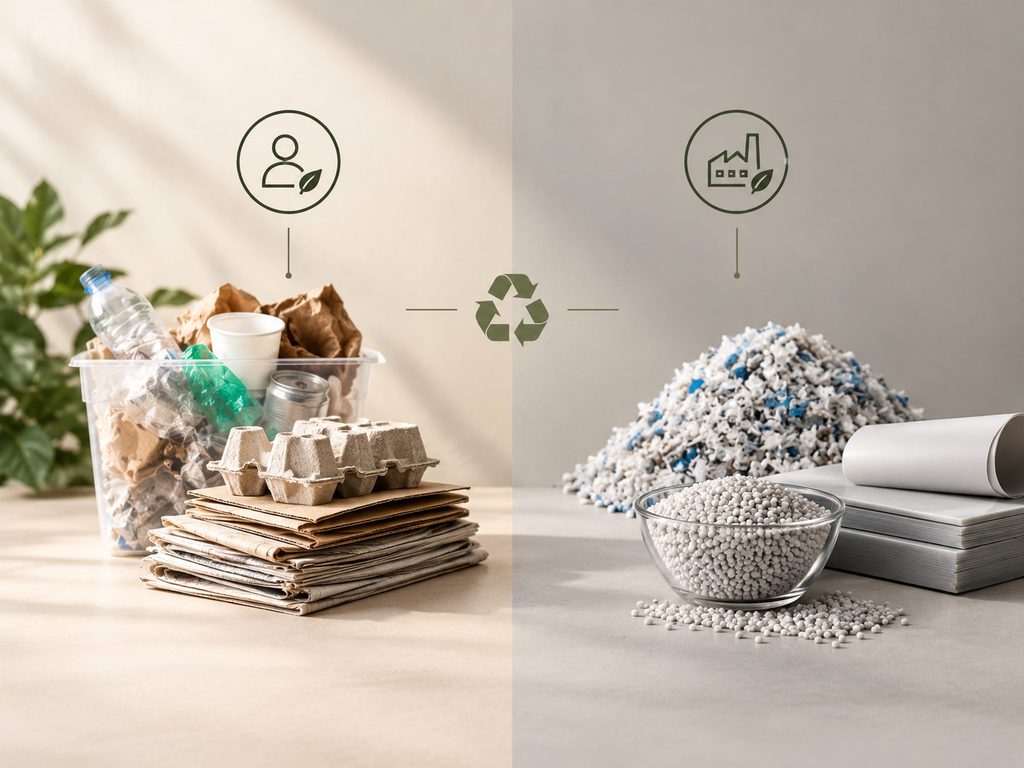
The most commercially exploited ambiguity in recycled content claims is the difference between post-consumer and post-industrial recycled material, and understanding it is the foundational distinction for evaluating any recycled content claim whose source isn’t specified.
Post-consumer recycled content is material that completed a full consumer use cycle, was collected through a recycling system, was processed and reintroduced into manufacturing as recovered material. It is material that was genuinely at risk of landfill or incineration, was diverted from that fate through a recycling process, and is now being used as a manufacturing input instead of virgin material. This is the environmental benefit that recycled content claims conventionally imply, and it’s the version that EPR schemes, retailer sustainability requirements, and regulatory bodies treat as the credible recycled content standard.
Post-industrial recycled content, sometimes called pre-consumer recycled content, is manufacturing waste or production surplus material that was redirected from one manufacturing process into another without ever reaching a consumer. It is recovered material in the technical sense but it is not the material that most consumers understand when they read recycled content on packaging because it was never on a trajectory to landfill or incineration. It was a manufacturing byproduct that would otherwise have been sold or repurposed as industrial waste, and its environmental benefit relative to virgin material, while real, is substantially more modest than the benefit of genuinely post-consumer recovered material.
If a supplier advertises recycled content, ask what percentage is post-consumer recycled versus post-industrial, since the two are sourced very differently and post-consumer recycled is generally viewed as the stronger sustainability signal. A recycled content claim that doesn’t specify the source is ambiguous by design, allowing the brand making the claim to benefit from the environmental implication of post-consumer recovery while potentially relying on post-industrial content whose provenance doesn’t warrant the same implication.
What Does Mass Balance Certification Actually Mean and Why Does It Matter?
The certification distinction that most recycled content buyers don’t know to ask about is the difference between mass balance and segregated chain-of-custody certification, and it matters because the two certification types produce fundamentally different levels of assurance about what is actually in the packaging being claimed.
Ask whether the certification is mass balance or segregated. Only segregated certification physically tracks the material from source to finished product.
Segregated certification means the recycled material being claimed is physically separated from conventional material throughout the supply chain from collection through processing to manufacturing. A packaging product with segregated certification contains the specific recycled material that the certification documents. The chain of custody is physical rather than accounting-based, and the material in the certified packaging is genuinely the material that the certification verifies.
Mass balance certification means the volume of recycled material entering a production system is matched against the volume of recycled content claims being made by products leaving that system, without requiring that any specific unit of product contains the specific recycled material whose volume justifies the claim. A packaging product with mass balance certification is produced in a system whose total recycled material input equals or exceeds its total recycled content claims across all products. The specific product you’re holding may or may not contain the material being claimed. It might be entirely virgin material whose claim is supported by the recycled content that a different product in the same production run received.
The practical consequence is that mass balance certification allows recycled content claims on products that don’t physically contain recycled material, provided the overall production system’s recycled material balance supports the claim in aggregate. This is legally compliant under current certification standards but creates a material difference between what segregated and mass balance claims represent that the recycled content label doesn’t communicate to the buyer or the end consumer.
What Evidence Does a Genuine Recycled Content Claim Actually Require?
Recycled content is not simply a marketing description. It is a measurable product characteristic. ISO 14021:2026 defines recycled content as the proportion by mass of recycled material contained in, or attributed to, a product, component or packaging. Evidence verification should happen before the claim reaches packaging, advertising, product pages or sustainability reports.
The evidence chain that supports a genuine recycled content claim at the product level includes several distinct documentation types whose individual adequacy determines whether the overall claim holds up under scrutiny.
Supplier declaration with traceable data is the starting point. A supplier who can provide a written declaration of recycled content percentage distinguishing post-consumer from post-industrial content, the material source, the test method used to verify the percentage, and the chain of custody documentation linking the declared source to the finished product is providing the foundational evidence that a claim requires. A supplier who provides a general statement that their products use recycled content without these specific elements is providing a claim rather than evidence.
Third-party certification provides the independent verification layer that makes supplier declarations credible to buyers who can’t independently verify supply chain claims. FSC chain-of-custody certification with its specific license code format, FSC-C followed by a six-digit number, allows verification against the FSC public registry whose accessibility means the certification status can be confirmed by anyone rather than requiring trust in the supplier’s own declarations. A supplier who claims FSC certification but cannot provide a license code isn’t FSC certified.
Test method documentation identifies how the recycled content percentage was measured, which matters because different test methods produce different results and some are more rigorous than others. Recycled content claims require documentation of the percentage, the test method used, and ideally third-party verification or supplier declarations with traceable data. A supplier who can identify the specific test method used to determine the recycled content percentage is providing information that allows the claim’s methodological basis to be assessed independently.
How Do You Identify Greenwashing Language on Packaging?
Greenwashing rarely announces itself. It typically appears as language that sounds meaningful but lacks specificity. The difference between a verifiable claim and a marketing claim is the difference between a testable statement and an untestable impression.
Consider the difference between these two statements. A vague and high-risk statement reads something like our bags are environmentally friendly and made with sustainable practices. A verifiable and lower-risk alternative states that the bags contain 80 percent post-consumer recycled content, verified by a specific test method, with FSC chain-of-custody certification and a visible license code. The first statement offers no testable criteria. The second provides specific claims that can be verified against documentation and public registries.
The specific language patterns that indicate marketing claims rather than genuine recycled content follow consistent patterns across enforcement cases and regulatory guidance. Eco-friendly, green, sustainable, and earth-friendly are the highest-risk category because they are broad enough to mean anything and specific enough to mean nothing, and regulators across the UK, EU, and US have all issued guidance warning businesses about making broad general claims without supporting specifics. France’s JEP ruled against brands specifically for using sustainable packaging without providing lifecycle assessment data to support the claim.
Made with recycled materials without a percentage is the second pattern because it provides no basis for assessing the magnitude of the claim’s environmental benefit. A product containing two percent recycled content and a product containing eighty percent recycled content can both truthfully claim to be made with recycled materials, and the phrase without a percentage distinguishes neither from the other. Genuine recycled content communication includes a specific percentage and distinguishes the source.
Recyclable without qualification is a third pattern that enforcement agencies have pursued specifically because a material being technically recyclable in specialist facilities is not equivalent to consumer-facing recyclability in mainstream recycling infrastructure. A product made from a material that can be recycled in certain industrial processes but is not collected in most residential recycling programmes can technically claim recyclable while creating a misleading impression about what consumers can actually do with the packaging after use.
What Regulatory Framework Governs Recycled Content Claims in 2026?
The regulatory pressure on recycled content claims has intensified substantially in 2025 and 2026 through a combination of new legislation, enforcement actions, and guidance updates that collectively raise the substantiation standard above what many brands currently meet.
The FTC emphasises that environmental claims should be supported by competent and reliable evidence and that marketers are responsible for both explicit statements and the impressions their claims create. This impression responsibility is the provision that catches marketing language designed to imply an environmental benefit without technically stating one, because the FTC’s enforcement considers the net impression created by the packaging’s full communication rather than only the literal accuracy of individual claims.
The EU is moving in the same direction. Directive EU 2024/825 introduces stronger restrictions on generic environmental claims and requires EU countries to apply the new rules from 27 September 2026. Even with the proposed EU Green Claims Directive facing potential withdrawal as of June 2025, enforcement continues under the EU Unfair Commercial Practices Directive and national consumer protection laws. Germany’s courts have been particularly active in requiring third-party substantiation for supply chain environmental claims.
California’s SB 343 prohibits certain recyclability claims for products whose materials aren’t recyclable through facilities available to at least 60 percent of the state’s population. This infrastructure availability standard means that a material’s technical recyclability isn’t sufficient for a California-compliant recyclability claim without verification that the recycling infrastructure supporting that recyclability is accessible to the relevant consumer base.
Supply chain sustainability claims are impossible for consumers to verify independently, making third-party certification the minimum standard regulators expect. Company self-declarations of sustainable sourcing are treated by most national enforcement authorities as inherently unverifiable and therefore misleading when used without certification logos. If the response to a request for substantiation is vague or noncommittal, treat it as a warning sign.
What Questions Should You Ask a Packaging Supplier Before Accepting a Recycled Content Claim?
The verification process that separates genuine recycled content from marketing claims requires asking specific questions whose answers either confirm the claim’s substantiation or reveal its absence. Whenever a supplier makes a sustainability claim, ask them to prove it. They should be able to provide certification, testing data, lifecycle information or chain-of-custody documentation.
The seven questions that provide the most diagnostic information about whether a recycled content claim is genuine are as follows. Is the recycled content verified by an independent third party rather than self-declared by the supplier or manufacturer? Can the materials be traced to a post-consumer source rather than a post-industrial or manufacturing surplus source? Which specific sustainability certifications support these claims and what are their license codes that allow public registry verification? What percentage of the packaging by weight is recycled content and what percentage is virgin material? What test method was used to determine the recycled content percentage? Is the certification mass balance or segregated chain-of-custody? What documentation can the supplier provide to a buyer’s legal or ESG team if the claim is scrutinised?
A supplier who can answer all seven questions specifically and provide supporting documentation is making a claim that has been built on evidence. A supplier who provides vague or defensive responses to specific questions is making a claim that hasn’t been built on evidence, regardless of how it appears on the packaging. If a supplier gives unclear answers, that may signal greenwashing.
What Happens to Brands Whose Packaging Claims Can’t Be Substantiated?
The commercial risk of recycled content claims that can’t be substantiated has increased materially alongside the regulatory and enforcement developments of 2025 and 2026, and the cost structure of that risk has changed from primarily reputational to increasingly financial and legal.
Cases like Reynolds paying $212,000 to Arizona raise a question for every brand printing sustainability claims on its packaging: can the documentation behind those claims hold up under scrutiny? That question has put new pressure on packaging procurement teams, who tend to hold the supplier records that legal, ESG, and regulatory teams now ask to see. The documentation question isn’t being asked only by regulators. It’s being asked by retail buyers whose own sustainability commitments require supplier substantiation, by ESG reporting teams whose scope three emissions calculations depend on accurate packaging material data, and by consumers whose ingredient and material literacy has developed to the point where specific claims invite specific verification attempts.
The practical consequence of this increased scrutiny is that recycled content claims whose substantiation was adequate under the lower-bar environment of 2020 may no longer be adequate under the scrutiny environment of 2026, and brands whose packaging carries claims developed against the earlier standard need to assess whether those claims can be substantiated under the current standard rather than assuming that unchanged claims carry unchanged compliance status. Marketing approval should not be the first time recycled-content evidence is examined. The strongest recycled-content claims are rarely built from one document.
